Outdoor Play

Best Longboard for Kids of 2026

The first thing most parents notice about a kids' longboard is how quickly a fun idea can turn into a scraped elbow. The right board is stable enough for a beginner, rolls smoothly over sidewalk seams, and survives being dropped at the park without developing a rattle. It should also be something a kid actually wants to ride. Over the past six months, we put 12 kids' longboards through that exact routine.

I've watched my own kids wobble onto boards that looked great but turned like shopping carts, and the difference usually comes down to truck tension, wheel grip, and whether the bearings roll freely from day one. A board that's too tall or too stiff can make a beginner feel like they're fighting the hardware, no matter how good it looks in photos. The picks below reflect that balance: smooth-rolling, sturdy, beginner-friendly, and worth the money, with designs that hold up to real kid use.

#1

Atom All-Terrain 39

Atom All-Terrain 39

Gravel and dirt

Doodle Score 9.6/10
Check Price

Worth Noting

  • Heaviest board here at 10 pounds
Wheels
78A, 100 x 65 mm
Deck Size
39 x 10 inches
Item Weight
10 lb
Load Capacity
220 lb
Read the full review

The wheels are what you notice first: 100 mm of 78A urethane, nearly four inches across, on a 39-inch drop deck. They are the reason this board rolls over gravel, packed dirt, boardwalk slats and the kind of fractured asphalt that stops an ordinary longboard dead.

Big wheels cost something. The board stands taller on them, so despite the drop deck a small rider has further to reach for the ground, and the whole thing weighs 10 pounds, the heaviest in this guide. It also carries the biggest price here by a wide margin, and that is the part most families have to think about.

What the money buys is a nine-ply maple deck, coarse 46-grit grip that holds a shoe even when the platform is dusty, and heat-treated trucks that do not ask for much attention. The 220-pound rating sits below a couple of the budget boards here, which only matters if a parent plans to ride it too.

We were struck by how much ground this opens up. If the riding around you is smooth pavement and a park path, the premium is hard to justify over the Playshion. If it is gravel, root-lifted asphalt or a farm track, nothing else here covers it, and the extra spend buys a board that gets used instead of one that stays in the garage.

Bottom line: Our pick for families whose riding happens on gravel, dirt or badly broken asphalt; nothing else here rolls over that ground, and the price reflects it.
#2

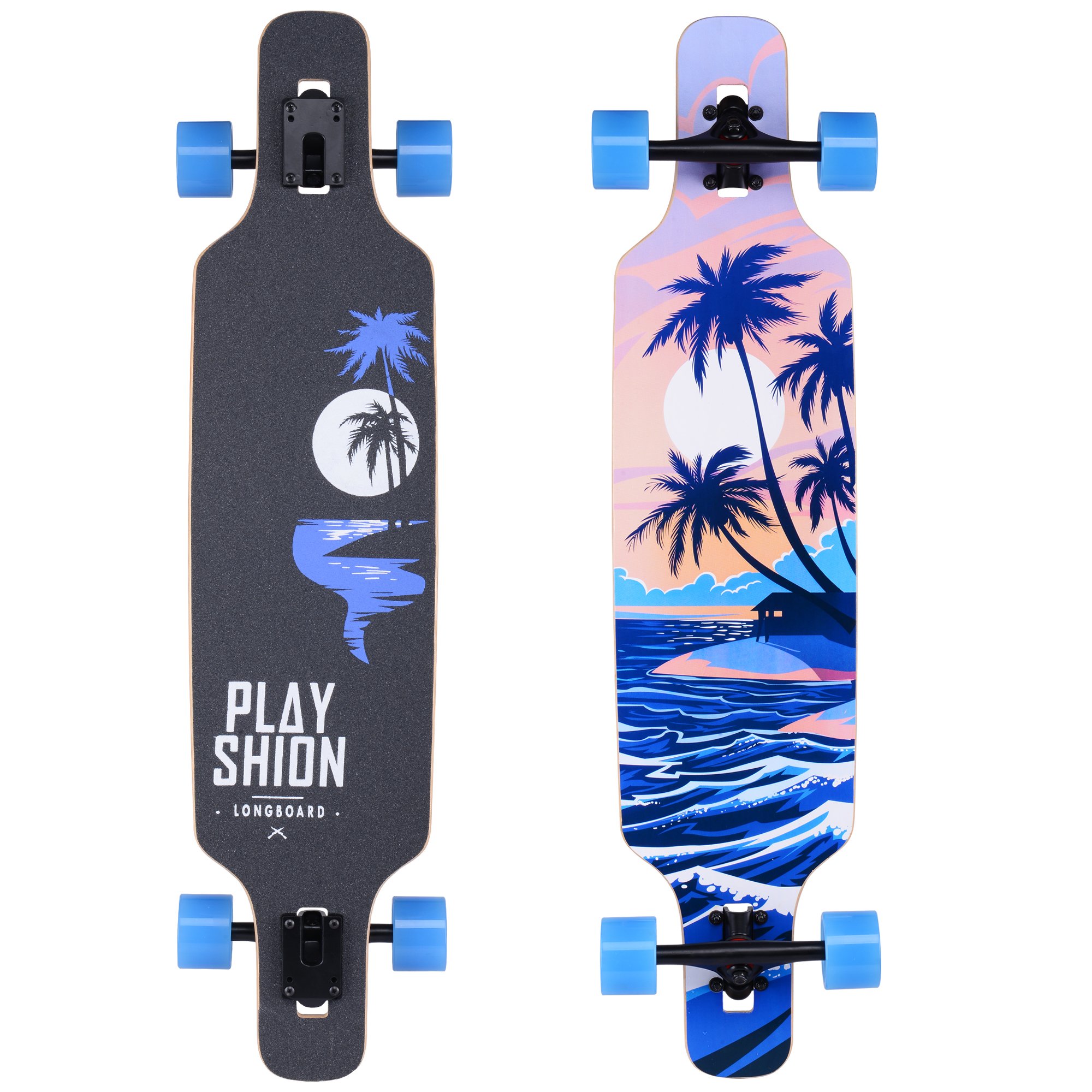
Playshion 39-Inch Drop-Through

Playshion 39-Inch Drop-Through

First longboard

Doodle Score 9.4/10
Check Price

Worth Noting

  • Deck can crack around the truck mounts
  • Bearings are serviceable rather than special
Wheels
78A, 70 x 51 mm
Deck Size
39 x 9.1 inches
Deck Style
Drop-through
Load Capacity
250 lb
Read the full review

The deck sits about as low as a longboard gets, and that is the whole argument for starting a kid here. Drop-through trucks bolt through the platform instead of hanging under it, which drops the rider closer to the pavement, close enough that a shorter, lighter beginner can get a foot down and foot-brake without the board skating out from under them. Of everything in this guide, it is the board we put under the smallest confident rider.

The wheels finish the job. Soft 78A urethane soaks up the cracks, gutter lips and slab joints of an ordinary suburban sidewalk, where the firmer 85A wheels on a couple of boards here send every one of those bumps straight up through the deck. At 39 by 9.1 inches there is room for a proper stance without so much deck that it becomes a two-handed carry, and the 250-pound rating covers a teenager comfortably. It comes assembled, so the first ride is the first ride.

The trucks usually arrive set tight, which makes the board feel as if it only wants to go straight; back each kingpin nut off a quarter turn and the steering comes alive. The ABEC-9 bearings are serviceable rather than special, the first part an experienced rider upgrades and nothing a beginner needs to worry about. The maple deck is the part that takes the punishment, so a monthly look at the four corners around the truck mounts is two minutes well spent.

Bottom line: We think this is the right first longboard for most kids: the lowest deck here makes pushing and stopping easy, and the soft wheels handle real sidewalks.

#3

Magneto 44-Inch Kicktail

Magneto 44-Inch Kicktail

Sharing with a teen

Doodle Score 9.4/10
Check Price

Worth Noting

  • No manufacturer warranty
  • Heavy to carry at 9.5 pounds
Wheels
78A, 70 mm
Deck Size
44 x 9 inches
Item Weight
9.5 lb
Load Capacity
275 lb
Read the full review

A kicked tail on a 44-inch deck is the difference between a board you stand on and a board you steer. That upturn at the back lets a rider lift the nose over a curb, pivot out of a driveway and swing a tight corner on the school run without stepping off, which is the move that turns a longboard from a toy into transport. It is the feature we reach for whenever the route includes a sidewalk lip or a busy corner.

The rest of the package holds up. Soft 78A wheels roll over chip seal and patched asphalt with far less chatter than the firmer wheels on a couple of boards here, and the 275-pound rating is the highest of any kicktail board in this guide, so a teenager and a parent can genuinely share it. We appreciated that a skate tool comes in the box, because trucks loosen and the right tool in a kitchen drawer stops a wobbly session from becoming an excuse not to ride.

One thing to weigh: the maple core has split on some of these after a month of hard riding, usually along the middle plies rather than at the mounts, so a board that lives on smooth pavement is a safer bet than one used for curb drops and stairs. Set the trucks a quarter turn looser than they arrive and the kicktail starts earning its keep in the first session.

Bottom line: Buy this one if a teen and an adult will share it; the kicktail and 275-pound rating earn their keep, and the soft wheels keep rough pavement comfortable.

#4

Retrospec Zed 44

Retrospec Zed 44

Budget cruising

Doodle Score 9.2/10
Check Price

Worth Noting

  • 85A wheels buzz on rough pavement
  • A 44-inch deck takes up real space
Wheels
85A, 70 mm
Deck Size
44 x 10 inches
Item Weight
9.3 lb
Load Capacity
220 lb
Read the full review

This is the cheapest complete longboard in the guide, and it is also the most forgiving platform a beginner can stand on: 44 inches long, 10 inches wide, with a pintail shape that leaves room to shuffle a foot around while you work out where it belongs. We preferred it to anything else near its price for a family not yet sure the board will get used, because a long, wide deck makes the first month feel less like balancing practice.

The deck is bamboo over Canadian maple, which gives it a flex you can feel underfoot, a small spring out of a rough patch rather than a jolt. The 85A wheels are firmly on the hard side for this group, so the ride is quicker and buzzier than the soft-wheeled boards here; on smooth asphalt that is a pleasure, on chip seal a child feels every stone. It arrives assembled, the wheel wells are cut deep enough to keep the wheels from biting in a hard turn, and the trucks want a quarter turn out plus a drop of lubricant before the squeaking stops.

The one thing we wish were different is the deck's appetite for punishment. Cracks have appeared on these boards, and a truck has pulled free of the platform more than once. On smooth pavement, with a rider inside the 220-pound rating, it does the job it was bought for; taken off curbs and down stairs, it will not last. Buy it as a first board and a fair-weather cruiser, which is how most families use one anyway.

Bottom line: The board we hand to a family buying a first longboard on a tight budget: long, wide, forgiving, and cheap enough to replace if it never gets used.

#5

PINESKY 41

PINESKY 41

Bigger riders

Doodle Score 9.2/10
Check Price

Worth Noting

  • Thin deck can split under a heavy rider
Trucks
8-inch aluminum
Wheels
80A, 70 x 51 mm
Deck Size
41 x 9.5 inches
Load Capacity
330.7 lb
Read the full review

The headline figure is the load rating: 330.7 pounds, level with the highest in this guide and a hundred pounds above most of the field. That matters if the rider is a big fourteen-year-old, if a parent plans to borrow the board, or if the deck will be handed down through a growing family. It is the reason this one is on the list at all.

We noted that the low deck does more for a beginner than the capacity does. The trucks mount through a 41 by 9.5 inch platform that sits close to the ground, so a shorter rider gets a foot down easily, and the PU shock rings in the trucks take the edge off the chatter a stiff maple deck normally sends up through your heels. The 80A wheels land between the soft 78A urethane used on most boards here and the hard 85A on the Zed, which is enough grip for a damp sidewalk and enough roll to keep up with a bike.

Two things are worth knowing. The maple is thin for what the rating suggests, and splitting around the middle can appear within a couple of months under a heavy rider, so the capacity number is not the same thing as toughness. The T-tool in the box is a genuine convenience, and the board arrives assembled with nothing to do before the first push except check the bolts.

Bottom line: For a big teen or a parent who wants a turn, this is the capacity pick, with a low deck and a T-tool in the box; keep the rider's weight in mind.

#6

VOLADOR 42 Freeride

VOLADOR 42 Freeride

Learning to carve

Doodle Score 9.2/10
Check Price

Worth Noting

  • ⚠️ Deck can snap at the truck mounts
Wheels
78A, 70 x 51 mm
Deck Size
42 x 9 inches
Load Capacity
220 lb
Truck Adjustment
45 to 55 degrees
Read the full review

The adjustable trucks are the part we loved most: the hanger angle can be set anywhere between 45 and 55 degrees, so the same board can be tuned steady for a nervous beginner and quick for a teenager who has found their balance. That is unusual at this money, and it means the board grows with the rider instead of being outgrown in a season.

Around those trucks sits a 42 by 9 inch drop-through deck with camber and concave, a gentle arch along the length and a lip at the edges that cups a shoe in a carve. The 78A center-cored wheels are soft enough for sidewalk joints, the ABEC-9 bearings roll freely, and the graphic on the underside is a cut above the plain-stained decks elsewhere in this guide.

Where it lands is straightforward: for a teenager who wants to learn to carve, the tuning options beat anything cheaper here. Treat the hardware check as mandatory, because bolts have arrived loose enough to need tightening before the first ride, and look over the deck around the truck mounts regularly, since that is where the maple gives way and a snap there is a fall. For a lighter rider on smooth ground it is a satisfying board that rewards the effort.

Bottom line: The tunable choice for a teen who wants to learn to carve rather than just cruise, as long as you accept that the deck is the part that gives way.

#7

Retrospec Rift 41

Retrospec Rift 41

Light carry

Doodle Score 9.2/10
Check Price

Worth Noting

  • Bearings may need replacing out of the box
  • Deck can crack after a few sessions
Wheels
78A, 70 x 51 mm
Deck Size
41 x 10 inches
Item Weight
7.1 lb
Load Capacity
220 lb
Read the full review

Start with the roll, because that is where this board divides. On paper the parts are right, with 78A wheels, ABEC-7 stainless bearings and a drop-through maple deck, but a wheel that stops spinning after a second or two is a bearing packed with grease or an axle nut done up too tight, and a board that will not coast is a board a kid gives up on.

The rest of it is a good beginner's package. The drop-through mounting puts the platform close to the ground, the 41 by 10 inch deck is wide enough that a stance does not feel like a tightrope, and at 7.1 pounds it is one of the lightest boards in this guide, which matters when the person carrying it to the park is eleven and the walk is half a mile. Soft 78A wheels handle sidewalk joints without drama, and the 220-pound rating covers most teenagers.

What surprised us is how much the experience hinges on that first spin. A free-rolling set makes this a stable, easy cruiser that a beginner can learn on comfortably; a draggy set makes it feel as if the brake is half on, and no amount of practice fixes that. New bearings cost little and take ten minutes, so it is a solvable problem, but solve it before the first session rather than after the third.

Bottom line: A light, stable drop-through for the kid who carries their own board, provided you check the bearings before the first ride.

#8

Amrgot 42 Drop-Through

Amrgot 42 Drop-Through

Lightest deck

Doodle Score 9.0/10
Check Price

Worth Noting

  • T-tool not always in the box
  • Hard 83A wheels on rough pavement
Wheels
83A, 70 mm
Deck Size
42 x 9 inches
Item Weight
6 lb
Load Capacity
330 lb
Read the full review

Open the box before the birthday. The listing promises a T-tool and the hardware on these arrives on the loose side, so the first job is a pass over every truck bolt and wheel nut with whatever tool you own. That is true of most budget longboards, but it is worth saying out loud here, because the deck underneath is better than the money suggests.

Six pounds is the lightest board in this guide, and 42 inches of nine-ply maple with a 330-pound rating is the sort of combination that usually costs more. A child can carry it one-handed, which sounds trivial until you watch a ten-year-old wrestle a 10-pound board through a park gate. The drop-through mounting keeps the platform low, and the printed underside is genuinely sharp rather than the muddled transfer print you expect at this level.

The rolling stock is where the corners were cut. The 83A wheels are among the hardest here, so a rough sidewalk comes up through the deck, and the bearings are the part most likely to be swapped in the first month. Plan for wheels and bearings as part of the purchase rather than as an upgrade later; the deck, trucks and grip are good enough that the money is well spent.

We paid close attention to the deck because that is the part you cannot replace cheaply, and it is the part that lasts. The breakage that turns up happens after months of hard riding, usually under a rider who has been jumping it, not on the first afternoon. For a light rider who wants a good platform now and will add better wheels later, it makes more sense than spending the difference on a fancier graphic.

Bottom line: The lightest board here, and a sensible buy if you plan to replace the wheels and bearings anyway; the deck is the part worth paying for.

How We Tested Kids' Longboards

We built the shortlist by researching more than 20 kids' longboards, then narrowing them by deck size, wheel shape, truck adjustability, and what came in the box, especially whether a skate tool was included. Price mattered, but only alongside build quality and design that kids would actually want to ride. Twelve boards made the cut, and we tested them for six months.

Each board was assembled out of the box and set up for a kid-sized stance. We noted how many steps required tools, whether the included tool was usable, and how freely the wheels spun before and after truck adjustment. Then kids who had never ridden a longboard tried first pushes, gentle turns, and a chalk slalom on a flat park path, while more confident riders took the same boards over sidewalk seams, driveway cracks, and low curbs.

We watched for handling that felt twitchy or fought the rider, and checked bearings by spinning each wheel and listening for grit. Smooth ride mattered most on rough pavement, where we noted whether the deck buzzed or the wheels caught. For durability and build quality, we inspected decks for chips, trucks for loosening, and wheels for flat spots after repeated sessions; we also compared what each board included against its cost to judge value.

How to Choose the Right Longboard for Kids

Deck height decides how quickly they learn

A drop-through deck bolts the trucks through the platform, so the riding surface sits an inch or two lower than on a top-mounted board. For a child that difference is the whole game: they can reach the ground with a toe to push and to foot-brake, and a lower center of gravity makes the wobble that ends most first sessions much less likely. The trade-off is clearance, because a drop deck scrapes on curbs and speed bumps that a top-mount rides over.

If your rider is learning on a driveway and a suburban block, take the drop. If they already want to hop curbs and pivot out of tight spots, a kicktail on a shorter deck buys more than the extra stability does.

Length, weight and who ends up carrying it

Every board here runs from 39 to 44 inches, and the long ones are not automatically better. A 44-inch deck is more forgiving underfoot, but it is also a two-handed carry for a small child, awkward on a bus and hard to stand up in a hallway. Check the listed weight as closely as the length: this group runs from 6 to 10 pounds, and that gap is the difference between a board a kid takes to the park alone and one that waits for an adult with a car.

Match the deck to the rider rather than to the idea of stability. A 39-inch drop-through is plenty of platform for a nine-year-old; the extra five inches mostly helps adults.

Wheel hardness changes where the board works

Soft urethane around 78A is what you want for sidewalks, because it absorbs cracks and slab joints instead of passing them up through the deck. An 80A or 85A wheel rolls faster on smooth asphalt and wears longer, but a light rider feels every bump. Diameter matters just as much: a standard 70 mm wheel is the all-round choice, while the 100 mm wheels on the Atom roll over gravel and packed dirt that stop everything else here, at the cost of a taller stance and more weight to get moving.

Buy for the ground the board will actually cover. A gravel path and a smooth promenade call for different wheels, and no single board in this guide is best on both.

Load ratings tell you who can ride it, not how tough it is

Stated capacities here run from 220 to 330 pounds, and almost any teenager sits comfortably inside the lowest of them. The number is worth checking when an adult wants a borrow or when a rider is still growing into a bigger frame. What it does not tell you is how long the maple will last.

Ply count is not a durability guarantee either. An eight-ply deck from one maker and an eight-ply deck from another behave differently, and the failure that turns up most often is a split around the middle or where the trucks bolt through.

The five-minute check before the first ride

Budget longboards arrive assembled, not tuned. Spin each wheel: if it stops within a second or two, the bearing is over-greased or the axle nut is too tight, and a board that will not coast is a board a child will not enjoy. Run a wrench over every truck bolt and wheel nut, and back the kingpin nuts off a quarter turn if the board will only go in a straight line.

Doing this before the wrapping comes off saves a disappointing first session and tells you whether you are buying a board or a project.

Frequently Asked Questions

Final Verdict

Most families should buy the Playshion 39. It has the lowest deck in this guide, the softest sensible wheels and a size a nine- or ten-year-old can carry without help, which are the three things that decide whether a longboard becomes a habit or garage clutter.

Spend more only for a reason. The Atom All-Terrain earns its premium on gravel and broken asphalt, and if a teenager and an adult will share one board, the Magneto's kicktail and higher capacity make it the better household buy.