Games & Puzzles

Best Puzzle Mats of 2026

A half-finished jigsaw on the dining table is a hostage situation. You can't set the table, you can't put the puzzle away without surrendering four evenings of work, and the cat has already claimed the corner pieces. A puzzle mat solves exactly that: you roll the whole thing up, puzzle and all, stand it in a closet, and unroll it later to find the border where you left it. My team and I spent four months with 14 of them — thin felt sheets, inflatable tubes, hinged fold-up boards — and the gap between a mat that protects your progress and one that dumps it on the rug comes down to a few unglamorous details.

Here's what nobody tells a first-time buyer: the size printed on the packaging is the outer edge, not the working area, so a mat that claims to hold a 1,000-piece puzzle can leave your border hanging off the felt. Rollability matters just as much — a mat that creeps sideways as you roll will shuffle pieces out of alignment before it's even in the closet. What follows are the ones worth clearing table space for, whether you puzzle weekly or haul it out twice a winter.

#1

Pohxev Puzzle Mat Roll Up

Pohxev Puzzle Mat Roll Up

2,000-piece puzzles

Doodle Score 9.4/10
Check Price

Worth Noting

  • Needs a genuinely big table
  • Heaviest roll-up in this group
Surface
Rubber
Included
6 sorting trays, storage bag
Mat Size
48 x 30.7 in
Puzzle Capacity
Up to 2,000 pieces
Read the full review

Forty-eight by thirty-one inches is a lot of mat, and for once the capacity claim holds up: this is the only roll-up here rated for 2,000 pieces. That extra width matters at the edges, where a big build needs somewhere to park loose pieces without them creeping into the roll.

We were happy to trade table space for that room. The rubber surface grips the table and gives pieces enough friction to stay where you put them, and the printed size chart is genuinely useful on a mat this big. It also ships rolled inside a long box rather than folded flat — worth knowing, because folded mats always arrive creased. Six sorting trays come with it, and they are the difference between a 2,000-piece build being a pleasure and being a hunt.

The cost is space and weight. At roughly four and a half pounds it is the heaviest roll-up here, and a 48-inch mat needs a 48-inch table; with six trays on the same surface, a small dining table will feel crowded. Check the rubber backing when it arrives, too — a mat that turns up creased or cracked along a fold is worth exchanging before the first puzzle goes on it.

Bottom line: Our choice for puzzles past 1,500 pieces: the largest working area in this group, six sorting trays, and a rubber base that stays put.
#2

Newverest Roll-Up Puzzle Mat

Newverest Roll-Up Puzzle Mat

Most households

Doodle Score 9.2/10
Check Price

Worth Noting

  • Tops out at 1,500 pieces
  • Priciest roll-up in this group
Surface
Polyester top, rubber base
Included
3 sorting trays, storage bag
Mat Size
46 x 26 in
Puzzle Capacity
Up to 1,500 pieces
Read the full review

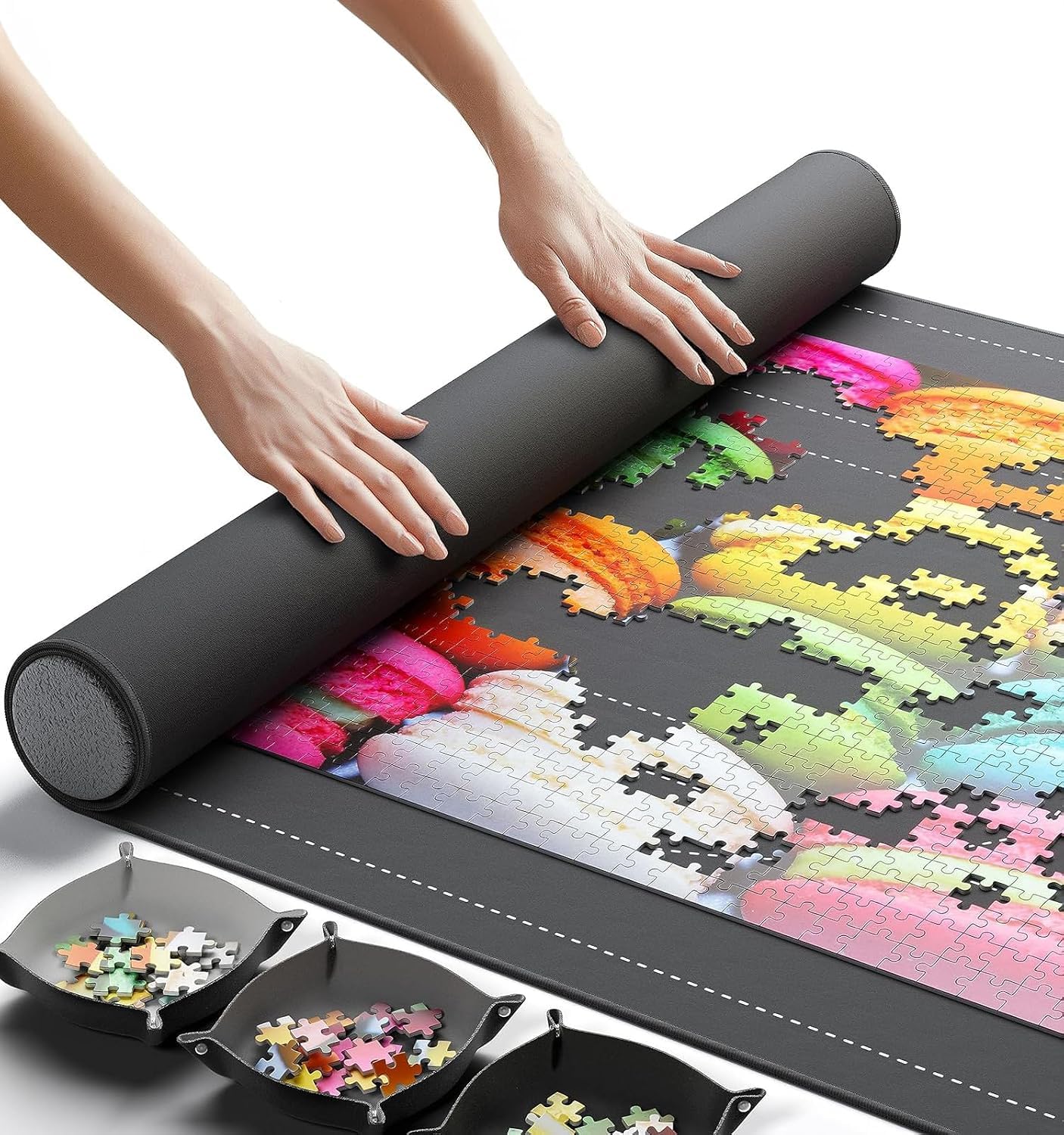
The difference between a roll-up you keep using and one that ends up at the back of a closet is usually the surface. Newverest puts a smooth polyester top over a rubber backing instead of the thin felt most of these mats use, and it changes both halves of the job: the rubber holds the mat still on a table, while pieces slide and regroup on the polyester instead of snagging. At 46 by 26 inches it is built for up to 1,500 pieces, and it is the one we recommend first.

The rolling hardware is where it pulls ahead of the felt-and-tube mats. A wide foam roller replaces the inflatable tube, so there is nothing to leak or inflate partway through a build, and three hook-and-loop straps hold the roll rather than the usual two — the middle of a 46-inch mat does not gap. The printed size chart on the mat itself is a small thing we came back to again and again, because it lets you check a puzzle's finished dimensions before you commit an evening to it.

Three sorting trays and a drawstring bag come in the box, enough to keep loose pieces off the floor and the whole roll out of the way between sessions. Leave a margin at the edges when you roll and the first turn will not grab a loose piece. It is the mat we reach for when the puzzle has to disappear before dinner.

Bottom line: We recommend this one first: the rubber base grips, the smooth top lets pieces slide, and the foam roller cannot deflate halfway through a build.

#3

ropoda Puzzle Mat Roll Up

ropoda Puzzle Mat Roll Up

Tight cupboards

Doodle Score 9.2/10
Check Price

Worth Noting

  • Sparse printed size guide
  • A few pieces can work loose at the roll ends
Surface
Polyester top, natural rubber base
Mat Size
46 x 26 in
Stored Size
3.9 in wide, 27 in tall
Puzzle Capacity
Up to 1,500 pieces
Read the full review

Rolled up, this one is a cylinder about four inches across and 27 inches long, which is the whole argument for it: it stands in a closet corner or slides behind a sofa and the table comes back. What we liked most is that it solves the storage question without asking you to give up capacity — the mat itself is a full 46 by 26 inches, rated to 1,500 pieces, the same working area as mats that pack down far worse.

The build is polyester over a natural rubber base, so the mat grips the table and pieces move predictably on top. Four sorting trays come with it, ten inches square and thin enough to stack flat when the puzzle goes away, plus three straps and a carry bag. The bag earns its place: a 27-inch roll is much easier to move and store with something around it, and it keeps dust out of the puzzle between sessions.

Nothing about a soft mat changes at this size: pieces at the very ends of the roll can come loose and need snapping back together when you unroll. It is a small tax on the convenience, and the only one we found worth mentioning.

Bottom line: Buy this when storage space decides the purchase: it packs into a slim cylinder and still takes a 1,500-piece puzzle.

#4

Tektalk Puzzle Board

Tektalk Puzzle Board

Homes with pets

Doodle Score 9.2/10
Check Price

Worth Noting

  • Runs tight for a full 1,000-piece puzzle
  • Flexes when carried loaded
Cover
Dust cover included
Surface
Flannelette over polyester
Board Size
30.7 x 20.9 in
Puzzle Capacity
Up to 1,000 pieces
Read the full review

A cover is the simplest idea in this whole category and the one that changes daily life most. Tektalk's board is a flannelette surface with a dust cover that goes over a part-built puzzle, so the thing can sit on a coffee table for a week without collecting dust, fur or a cat's attention.

The board measures 30.7 by 20.9 inches and is rated to 1,000 pieces, and it weighs little enough to lift from table to floor and back. Pieces stay put on the flannelette — that is the point of the nap — and the cover holds everything down while you carry it. It is not a roll-up: nothing compresses, so storage means a flat 30-inch footprint behind a sofa or under a bed.

Where it falls short is at the top of its range. A full 1,000-piece puzzle fills the board almost edge to edge, and a build that runs large will overhang, so measure the finished size if 1,000 pieces is your standard. The board also flexes when you carry it loaded, so support it underneath with both hands. Even with both caveats, this is the board we suggest to anyone whose puzzle shares a room with a pet — the cover does more for a part-built puzzle than any bag.

Bottom line: We point pet households here: the cover keeps a part-built puzzle in place and the whole board lifts off the table intact.

#5

TELY Foldaway Puzzle Board

TELY Foldaway Puzzle Board

Small rooms

Doodle Score 9.2/10
Check Price

Worth Noting

  • No cover included
Thickness
9 mm
Board Size
31.5 x 22.8 in
Folded Size
22.8 x 15.7 in
Puzzle Capacity
Up to 1,000 pieces
Read the full review

Fold it in half and TELY's board goes from 31.5 by 22.8 inches to roughly 22.8 by 15.7, small enough to stand behind a door or slide under a sofa. That single trick makes it the most apartment-friendly thing here, and at about a pound it is easy to move from room to room with a puzzle on it.

The catch is worth stating plainly, because it decides the purchase: the board folds when it is empty, not when it is loaded. A puzzle in progress has to be carried flat, so what you are really buying is compact storage for the board rather than a way to fold a puzzle away. The 9 mm felt surface is firm enough to bridge two TV trays, which is what makes it useful on a table that is too small or slightly uneven.

We think it is the right answer for a small flat where the board, not the puzzle, is the storage problem. The felt is coarser than the smooth mats here, and pieces snag a little when you slide a connected section into place — you lift and place instead. If the board goes into a cupboard each night, that is a small price for reclaiming the floor.

Bottom line: For a flat that has to be cleared away, this folds in half — as long as the puzzle is off it first.

#6

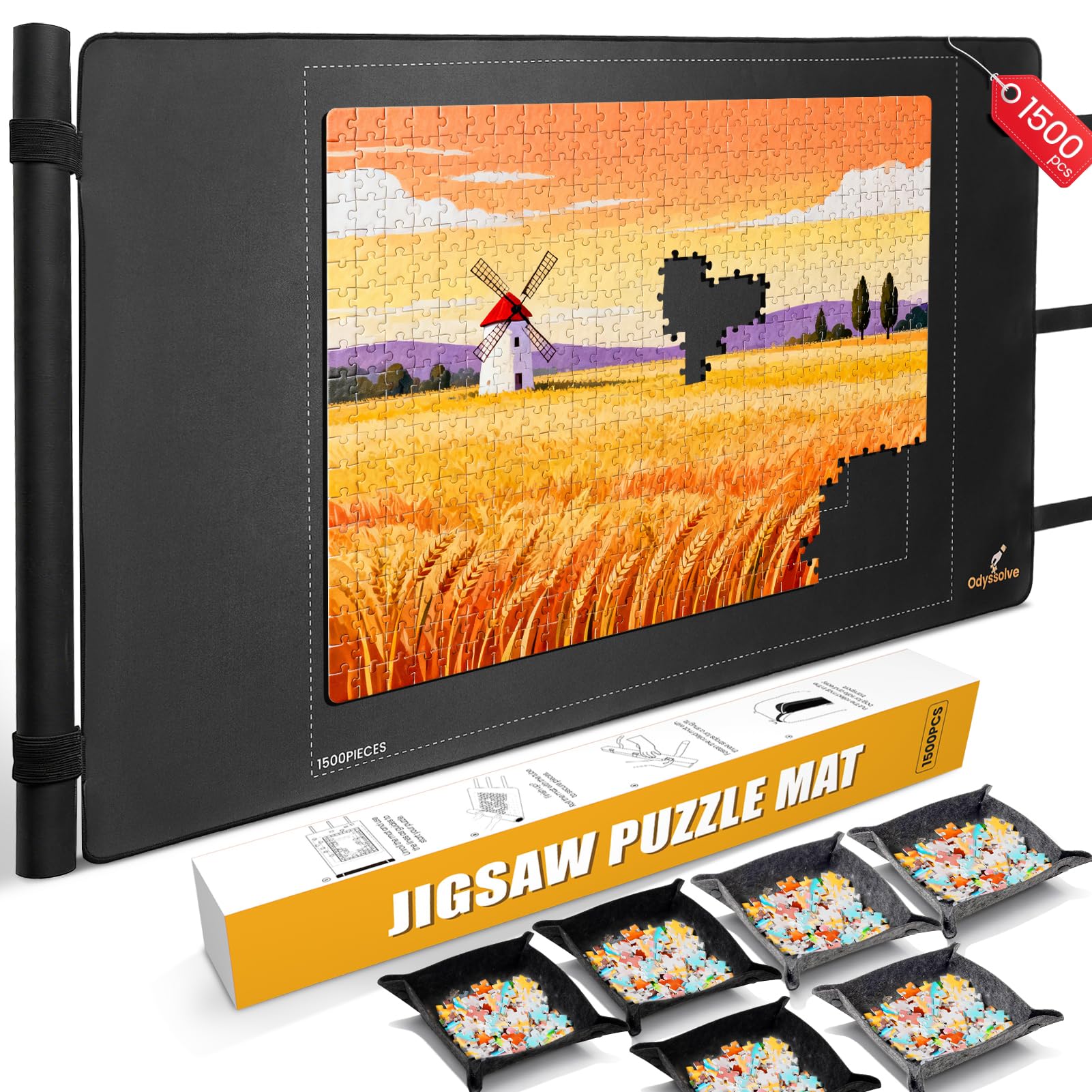
Odyssolve Puzzle Mat Roll Up

Odyssolve Puzzle Mat Roll Up

All-in-one kit

Doodle Score 8.8/10
Check Price

Worth Noting

  • Usable puzzle area is smaller than the mat
  • End pieces can come apart on unrolling
Surface
Rubber
Included
3 sorting trays, integrated roller, storage bag
Mat Size
46 x 26 in
Puzzle Capacity
Up to 1,500 pieces
Read the full review

The roller on this one is attached to the mat with a strap that stays with it, so there are no loose bands to hunt for in a cupboard. Unroll, build, roll, fasten, done — it is the tidiest version of the routine in this group.

The rest of the kit is familiar: a 46 by 26 inch rubber mat rated to 1,500 pieces, three sorting trays, a foam roller and a drawstring bag, all in packaging nice enough to give as a gift. The smooth top lets pieces slide and the rubber base keeps the mat from wandering on a hard table.

Then there is the margin. The mat prints a size chart on its surface, and the usable puzzle area inside those lines is smaller than 46 by 26. A 1,500-piece puzzle whose finished size runs close to the full mat will not fit inside it, and that is the sort of thing you discover halfway through the frame. Check the finished dimensions on the puzzle box before you buy.

What gave us pause is the unrolling. With a full load, pieces at the ends can fail to stay together, which costs a few minutes of rebuilding every time the puzzle comes out. The hardware is neat and the trays are useful; the fit is the thing to be sure about.

Bottom line: A tidy kit with the roller built in, but check your puzzle's finished size — the usable area is smaller than the mat.

#7

CallKroon Felt Puzzle Mat

CallKroon Felt Puzzle Mat

First-time buyers

Doodle Score 8.4/10
Check Price

Worth Noting

  • Only select 1,500-piece puzzles fit
Weight
10.2 oz
Included
4 sorting trays, inflatable tube
Mat Size
45 x 25 in
Puzzle Capacity
Up to 1,500 pieces
Read the full review

Open the box and you get a 45 by 25 inch felt mat, four sorting trays and an inflatable tube — the complete kit, with nothing obviously missing. For a first mat, or for someone who has just discovered jigsaws, that completeness is the appeal: the trays arrive with the mat rather than as an afterthought you pay for separately.

We appreciate that the instructions are straight about the mat's weakness. They tell you to flatten it before first use because creases from folded packaging are normal, and they are right — give it a day or two laid out flat and it settles. The felt is textured, which holds pieces where you put them; the flip side is that connected sections resist sliding, so you lift and place rather than pushing clusters across the mat.

An inflatable tube is the inexpensive way to do this, and it is the part to watch: if it loses air, a stored puzzle slumps. Inflate it firmly, use both elastic bands, and do not count on it surviving a season of being stuffed into a closet. For occasional puzzlers and smaller builds, none of that is a reason to spend more.

Bottom line: A first mat we are happy to recommend: four sorting trays, a 45 by 25 inch felt surface, and no second order to place.

How We Tested the Best Puzzle Mats

We built the shortlist by pulling every mat we could find — felt sheets with elastic straps, inflatable tubes, hinged boards that fold in quarters — then cutting anything whose claimed dimensions didn't survive a tape measure. Before any puzzle went down, we traced a standard 1,000-piece and a 1,500-piece footprint on each mat to see how much sorting room was left over, since the outer measurement on the box is not the area you actually get.

Each mat then went home with a tester and lived where puzzles really happen: a coffee table, a dining table, and a living-room floor, with kids, cats, and a spouse who wanted the table back for dinner. We assembled the same 1,000-piece puzzle on every one, noting whether pieces slid when nudged or stayed put, whether the surface was smooth enough to fan out pieces for sorting, and how long setup and cleanup took when done solo after work.

Then the part that actually decides it. We rolled and unrolled every mat five times, stood them on end in a closet for a month, and counted how many pieces had shifted, flipped, or escaped when we unrolled them again. We watched the edges for fraying after repeated rolls, checked whether hinged boards still lay flat at the seams, and weighed all of it against what each mat cost — a mat that saves your puzzle twice a year doesn't need to be the expensive one.

How to Choose Puzzle Mats

Match the working area to the puzzle, not the label

A mat sold as a 1,500-piece mat is not a guarantee. Finished puzzle sizes vary between makers, and the printed size chart on the mat eats into the usable area. The Odyssolve mat measures 46 by 26 inches, but the puzzle area inside its size lines is smaller, so a large 1,500-piece build can overhang. The Pohxev's 48 by 31 inches is the one to choose when your puzzles run big.

Check the finished dimensions on the puzzle box before you order, and leave an inch of margin at each edge so the first turn of the roll does not grab a loose piece.

Felt grips, polyester glides

The surface decides how you build. Felt has a nap that holds pieces where you drop them, which suits people who assemble in place; it also resists when you try to slide a connected section across, so you lift and place instead. Smooth polyester over a rubber base lets clusters glide, and the rubber keeps the whole mat from wandering on the table.

If you build by sliding pieces into position, buy smooth. If you build slowly, piece by piece, felt is fine and usually cheaper.

Foam rollers beat inflatable tubes

Most inexpensive mats roll around an inflatable tube; the better ones use a foam roller. Foam cannot leak, needs no inflating, and puts a gentler curve through the puzzle. Inflatable tubes pack smaller and cost less, but a slow leak can let a stored puzzle slump.

Packaging matters too. A mat that ships folded arrives creased and wants a day or two flat before the first build. The Pohxev ships rolled inside a long box rather than folded flat, which is worth knowing, because folded mats always arrive creased.

Roll-up or rigid board

A roll-up compresses, goes into a bag and lives behind a sofa. A rigid board cannot do that, but it holds a cover, lifts off the table in one piece and suits a puzzle that stays out for weeks. The Tektalk is the board we suggest when a cat shares the room.

The trade is footprint: a board needs somewhere flat to live when it is not on the table. If your table is cleared every night, buy a roll-up.

Trays, straps and bags

Sorting trays are the extra that earns its place. Four is plenty for a 1,000-piece build; six or more helps once you pass 2,000. Hook-and-loop straps hold a roll better than elastic bands, and three straps support the middle of a long mat. A drawstring bag keeps dust off and gives you something to carry.

None of this is essential — a baking sheet and a rubber band will get you started — but the kit is what makes a mat easy to live with.

Frequently Asked Questions

Final Verdict

If you want one mat and no fuss, buy the Newverest. Its rubber base and smooth top handle the two jobs a mat has — holding still and letting pieces move — and the foam roller does away with the inflatable tube entirely. Go to the Pohxev the moment your puzzles run past 1,500 pieces; nothing else here gives you the same working area, and the six trays match the scale of those builds.

If the puzzle has to live on a shared table with animals in the house, the covered Tektalk board is the more sensible answer, and the CallKroon is the one to start with if you are not yet sure the hobby will stick.