Games & Puzzles

Best Putty Toys of 2026

A good putty toy should give your hands something to do without leaving a greasy film on your keyboard. That's the line I kept coming back to after three months of squeezing, stretching, and rolling 14 different putties at my desk, at the kitchen table with my kids, and during a few long phone calls. The right one keeps fidgety fingers calm, gives therapy exercises some resistance, and stays where you put it. The wrong one crumbles, stains, or fights back.

Here's something I didn't know before this test: color often signals firmness, not just fun. A soft putty is great for stress relief but useless for hand-strength work, and a firm one can be too stiff for a kid. We looked at the whole range—from feather-light to extra-firm—and paid attention to how each one felt after ten minutes of use. The picks below are the ones that stayed workable, cleaned up easily, and didn't turn into a mess.

#1

Special Supplies Therapy Putty

Special Supplies Therapy Putty

Household hand therapy

Doodle Score 9.4/10
Check Price

Worth Noting

  • Extra-soft tin runs firmer than the name says
Material
Silicone
Total Putty
12 oz
Putty Per Tin
3 oz
Resistance Levels
4, extra soft to firm
Read the full review

Buying putty one tin at a time is a guessing game. Too soft and it does nothing for grip; too firm and a child gives up on it inside a minute. This set takes the guess out of it, with four three-ounce tins graded from extra soft to firm, all made from silicone rather than latex. That last part matters more than it sounds in a house with sensitive skin. A graded set is the sane first purchase in this category, and this is the one we hand people.

Three ounces per tin is a working amount rather than a sample, and twelve ounces across the four means a child, an adult and a spare tin by the sofa can all be in play. Working them side by side is the useful part: the soft tins give a slow, springy squeeze that suits stiff morning hands, and the firm one makes you actually push. Because each resistance has its own color, nobody has to squeeze four tins to find the right one.

Warm hands change the equation. Worked hard in a warm room, the softer grades turn tacky and start collecting lint, and a sleeve brushed across the tin will take a smear with it. We kept the soft tins in a cool drawer, handed out short sessions, and had no trouble; the firm tins were untroubled either way. Anyone using this for rehab wants that rhythm anyway, because the point is repeated short efforts rather than one long knead.

It is plain putty, with no charms, beads or mix-ins, so a child who wants a toy to explore will do better with a tin that has something hidden inside. As the household staple that stays in the drawer and gets used without ceremony, nothing else here comes close.

Bottom line: Four graded tins, silicone instead of latex, and a real working amount in each: this is the set we point a household to when nobody knows yet how firm they want their putty.

#2

INNER-ACTIVE Deep Blue Sea Putty

INNER-ACTIVE Deep Blue Sea Putty

Fine motor play

Doodle Score 9.0/10
Check Price

Worth Noting

  • One resistance only, so progression means another tin
Safety
ASTM F963 and CPSIA compliant
Resistance
Medium
Set Contents
3.5 oz putty, 10 charms
Tin Diameter
4 inches
Read the full review

Ten sea creatures are buried in this tin, and the whole toy is the search. You squeeze, knead and dig until the walrus surfaces, then bury it again for the next round. It is the only putty in this group with a game built into it, and that is what makes it work for a child who will not sit through a set of hand exercises.

We think the hidden-object idea is genuinely well executed, and it is not just decoration: pulling a small charm out of firm putty is a precise pinch, repeated ten times, which is exactly the movement a fine-motor session is aiming for. The medium resistance is a sensible middle, firm enough that retrieving a charm takes effort and soft enough that a four-year-old can start without help. It is silicone, latex-free, and certified to ASTM F963 and CPSIA, the sort of paperwork worth having on a toy that travels to school.

The tack is the trade-off. This putty holds onto its charms because it grips, and it grips cloth with the same enthusiasm, so a session on the sofa is a bad idea. We played over a wipe-clean table with the tin lid underneath as a resting place, and the putty stayed out of trouble all afternoon. Ten small pieces also need somewhere to live between sessions, since losing the crab down a cushion leaves you with nine.

Bottom line: A tin of putty with ten sea creatures buried in it, which turns a fine-motor workout into something a child asks to do again.

#3

Goody Putty Mini Tins 8-Pack

Goody Putty Mini Tins 8-Pack

Party favors

Doodle Score 9.0/10
Check Price

Worth Noting

  • Half-ounce tins are a taste, not a daily supply
Tins
8 mini tins
Scent
Unscented
Finish
Glitter, eight colors
Tin Volume
0.48 fl oz
Read the full review

Eight small tins, each in a different glitter color, and that is the point of the format. One tin per child means no dividing, no negotiating and no tears over who got the bigger piece. A party bag is solved in a single purchase, and it is why these turn up in classrooms and therapy bags as well as at birthdays.

The tins themselves are the quietly good part. They are small enough for a coat pocket, they open and close without a fight, and the putty inside is unscented, which matters in a room full of eight-year-olds. The colors are vivid enough to survive being shown off, and a tin that has been opened and closed all week still looks like something worth opening again.

It is as favors and rewards that this earns its place, and on that brief it is hard to beat. The tins do not all open at the same softness, so a stiff one needs a few minutes of kneading before it plays like the rest, and the very hardest are better handed to adult fingers than to a small child's. Neither wrinkle matters much when the tin is going home in a party bag.

Bottom line: We reach for this one when the putty has to be handed out rather than shared: eight tins, eight colors, no arguments.

#4

Educational Insights Pluffle 8-Pack

Educational Insights Pluffle 8-Pack

Sensory bins

Doodle Score 9.0/10
Check Price

Worth Noting

  • Sheds bits that need vacuuming after play
Tubes
8 mini tubes
Colors
Eight colors
Compound
Foam
Recommended Age
3 to 8 years
Read the full review

Pluffle is not putty you roll in your hands, and it is worth saying that plainly. It is a foam that moves like a slow liquid, pulls apart in soft clumps and refuses to hold any shape you give it. What it does instead is fill a sensory table better than sand, and it does not dry out the way dough and slime do.

That is where it earns a place on this list. Eight mini tubes in eight colors, mixable into new shades, and the part that convinced us, it vacuums out of carpet instead of grinding into it. For a preschool table, a playroom corner or a homeschool shelf, that combination is worth more than any amount of hand-feel, and it is the only thing here that survives being left set up for a week.

The rating is three to eight years, which is about right: the tubes are small and the foam invites squeezing between fingers, so a toddler needs eyes on them. Treat it as a bin filler with a tray and a floor underneath, and it earns its keep in a classroom rotation.

Bottom line: Not a handheld putty at all, but the best sensory-bin filler here: it never dries out, and it vacuums off the carpet.

#5

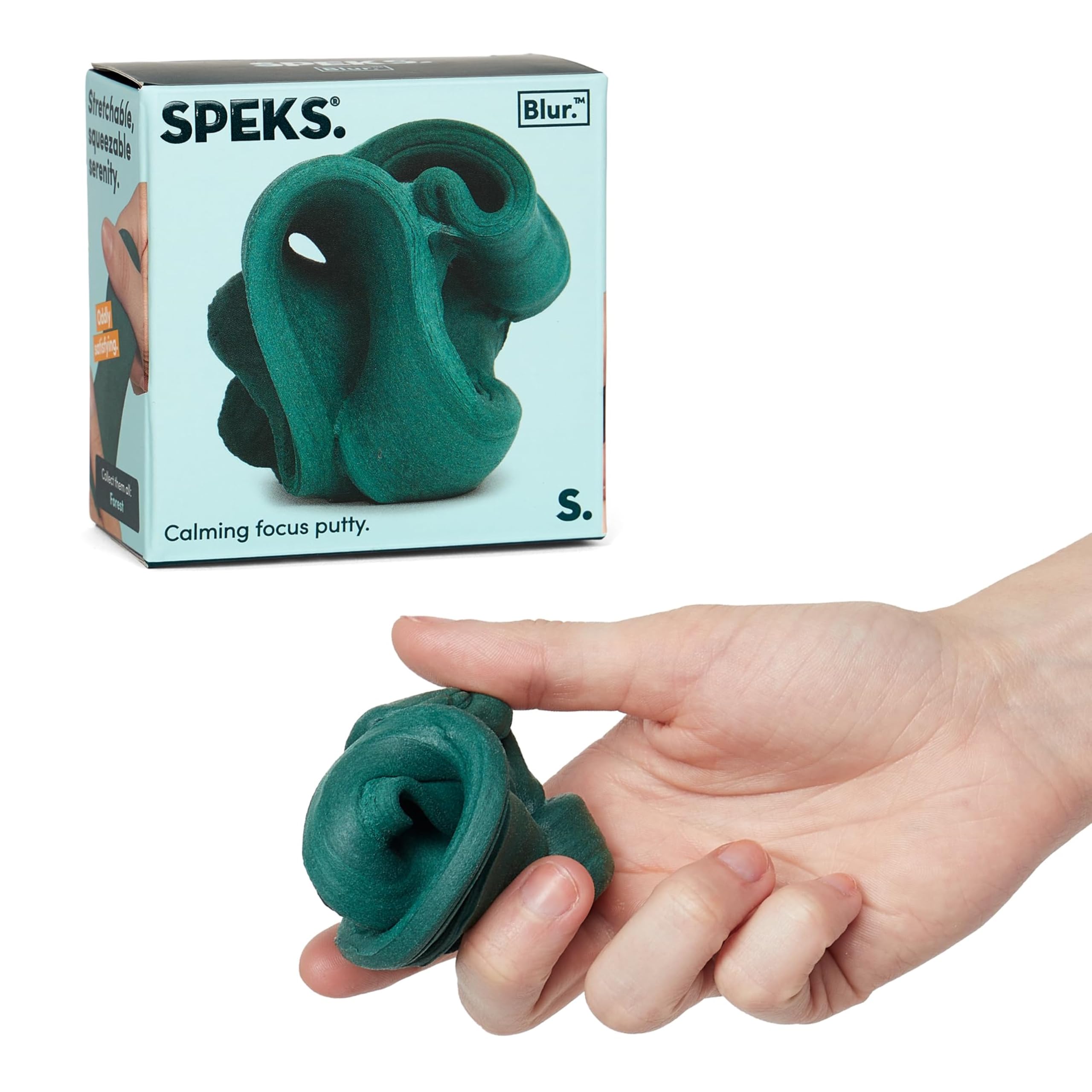
Speks Blur Thinking Putty

Speks Blur Thinking Putty

Quiet desk fidget

Doodle Score 8.8/10
Check Price

Worth Noting

  • Rated 14 and up, so it is not for younger kids
Color
Forest
Noise
Silent
Texture
Soft, airy foam putty
Recommended Age
14 years and up
Read the full review

What you notice first is the absence of noise. Blur does not crackle, pop or click; it stretches and folds in near silence, which is how it ended up in a bag next to a laptop rather than in a toy bin. The texture is the other surprise, soft and airy, closer to a marshmallow than to the dense silicone putty most of this group uses.

We rate it as the desk fidget of the bunch, and that is a narrower job than it sounds. It leaves no tack on your fingers, it does not shed, and it comes back to its shape after a session, so it can sit on a keyboard tray without an aftermath. The tin is small, matte and does not announce itself. For a teenager in a lecture or an adult on a call, that combination is the whole point of owning it.

Two things come with it. There is a faint plasticky smell when the tin is new, which fades once it has aired, and a long session leaves a light oily film on your hands, nothing a wash does not clear but worth knowing before you pick up a phone. Neither is enough to keep it off a desk, and a quick wash before you type is the entire adjustment.

Bottom line: The quietest putty here, and the one we leave on a desk: silent, non-sticky, and happy to sit in a drawer between sessions.

#6

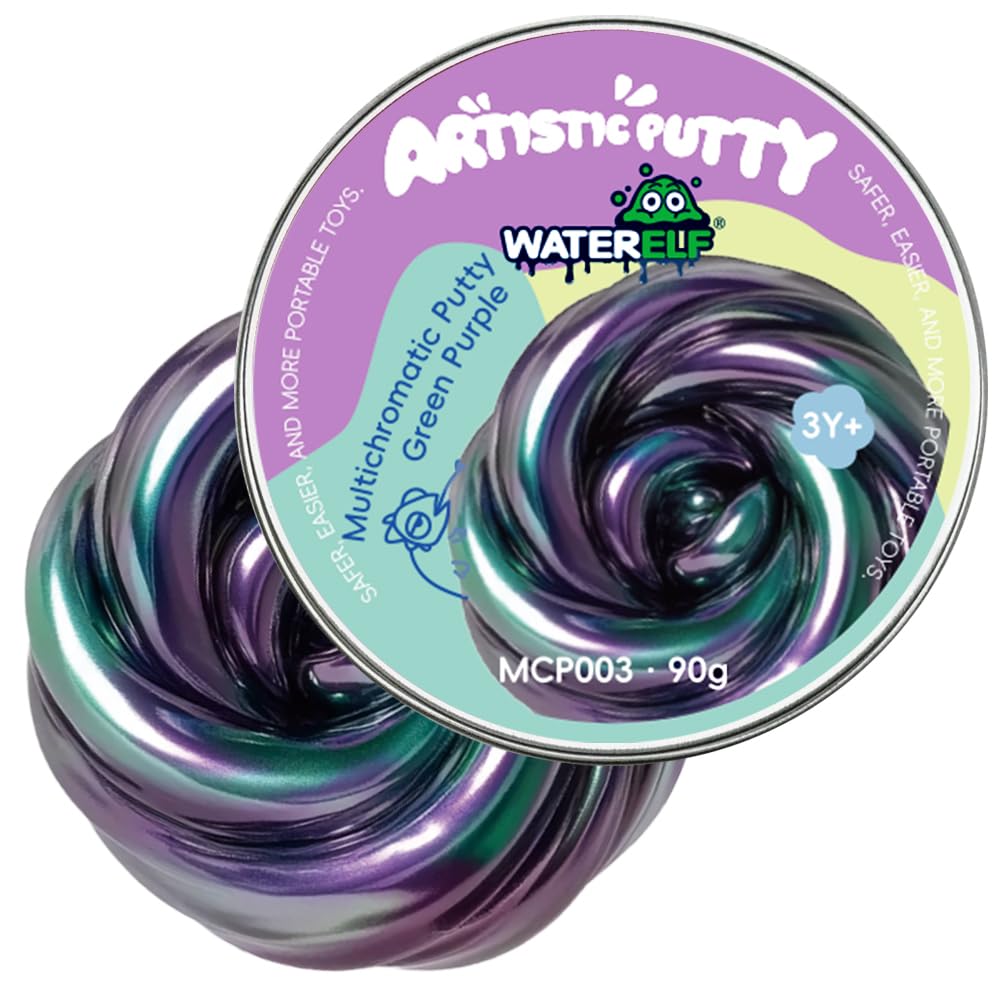
WATERELF Galaxy Putty

WATERELF Galaxy Putty

Firm, pretty putty

Doodle Score 8.8/10
Check Price

Worth Noting

  • Lid can be stiff to reopen after the seal breaks
Colors
Green and purple
Putty Weight
3.2 oz
Tin Diameter
3.11 inches
Recommended Age
36 months to 10 years
Read the full review

Ours arrived stiff. The first minute with this tin was less play than warm-up, kneading and folding and squeezing before it loosened into anything you could stretch. That is the honest first impression of the Galaxy putty, and it decides whether you will like it: it rewards patience and punishes a quick grab.

Once it warms, the finish does the work. The pearlescent green-purple shifts depending on whether you stretch it or break it, and there is enough depth in it that the tin looks more expensive than it is. At 3.11 inches across and 3.2 ounces, it is a solid single-person amount, and it holds its shape rather than slumping into a puddle the way softer putties do.

That firmness is why we kept it rather than a flaw to work around. Stretched slowly it draws into a long strand and stays there; pressed, it takes a shape and keeps it. If your experience of putty is soft and squishy, this feels like a different material, closer to a firm taffy, and for slow deliberate fidgeting with some resistance we prefer it to the soft tins.

The catch is speed. Pull it fast and it snaps off in the middle instead of stretching, and the pieces that tear away are fiddly to press back together. Patience with the pull is the entire technique, and once you have it, a session is calm rather than restless.

Bottom line: We keep this one for people who find soft putty mushy: it is firm, glossy and holds a shape, as long as you pull it slowly.

#7

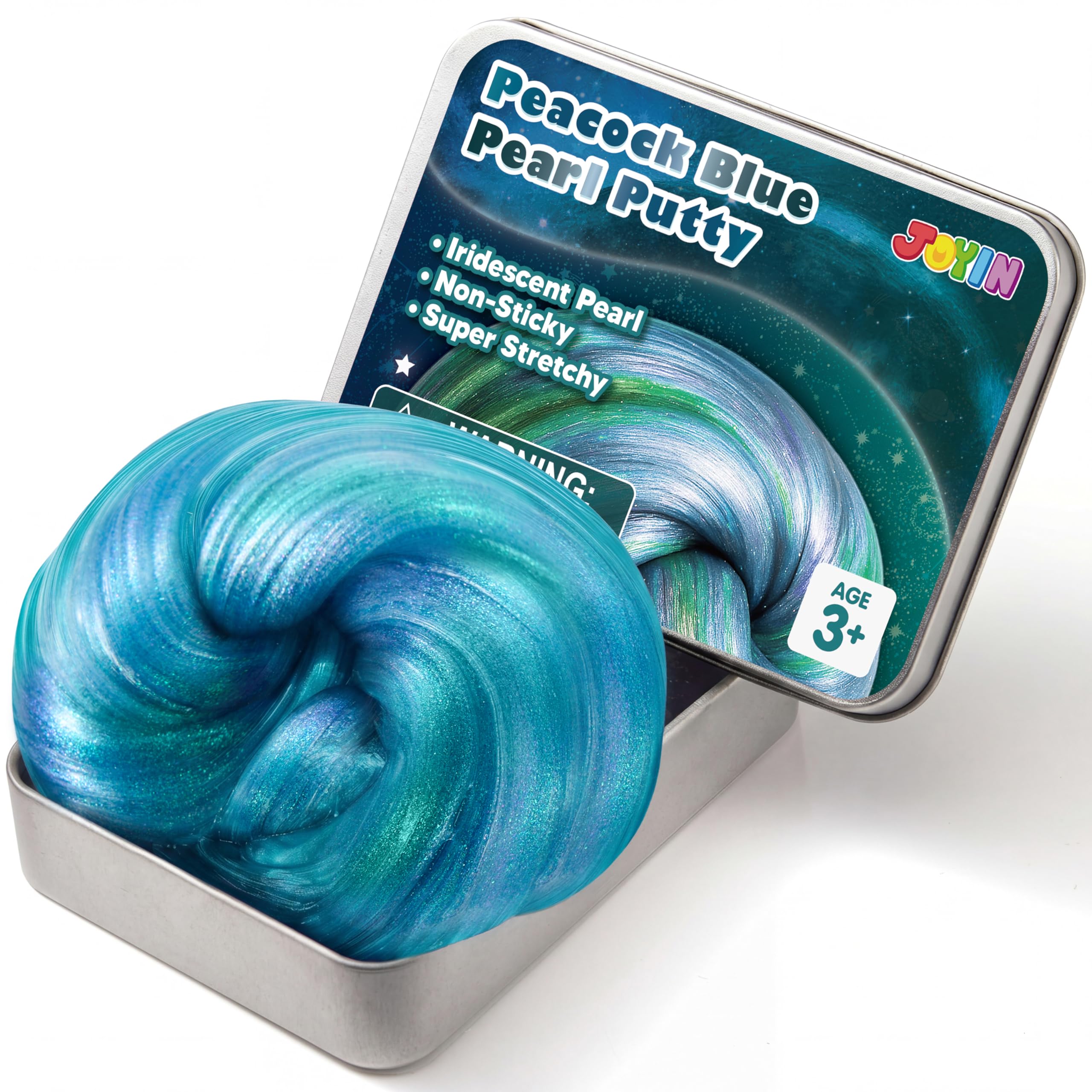
JOYIN Peacock Blue Pearl Putty

JOYIN Peacock Blue Pearl Putty

Gifting one tin

Doodle Score 8.6/10
Check Price

Worth Noting

  • Turns tacky on warm hands and marks fabric
Finish
Pearlescent peacock blue
Putty Weight
4.23 oz (120 g)
Recommended Age
3 years and up
Read the full review

Peacock blue with a pearl finish: in the tin it looks like a polished stone rather than a toy. It is the one in this group you could leave out on a desk without it reading as clutter, and the finish shifts as you fold it, which is most of the reason to pick it up in the first place.

The tin is 4.23 ounces and it arrives full, level with the rim, which is worth checking on any putty you buy. How it moves depends entirely on how you ask: pull slowly and it draws into a long, glossy strand that holds; yank it and it snaps off in the middle. Slow hands get the good version of this putty.

It runs firmer than a therapy putty, and that is a fair description rather than a criticism. Squeezed, it holds a shape; rolled, it stays where you put it. For fidgeting while reading or on a call, the resistance gives your hands something to do, and the pearl surface means it does not look worn out after a week of it.

For one person who wants one good tin rather than a set of eight, this is the pick. The pearl finish is also forgiving in a way clear putty is not, since dust and fingerprints do not advertise themselves on it, and a single nice tin is a much easier gift to hand over than a multipack.

Bottom line: One full, pearlescent tin that looks better than it needs to and stretches into a long glossy strand if you are patient with it.

How We Tested (and Lived With) 14 Putties

We started by pulling together a shortlist of 22 putties from therapy catalogs, toy aisles, and online reviews, then narrowed it to 14 based on firmness ranges and tin size. Each one came out of the tin for three months of daily use—at my desk during work calls, at the kitchen table with my kids, during a friend's hand-therapy exercises after a wrist injury, and on a long road trip. We kept a log of how each behaved after five minutes, an hour, and a week.

The first thing we did with every putty was squeeze it straight from the tin. Some were stiff enough to hurt the heel of my hand; others slumped into a puddle before I could roll a ball. We noted whether it held a shape or sagged, and whether it left a slick or tacky film on our palms. For the therapy-focused ones, we ran through finger spreads, thumb presses, and wrist curls, checking whether the resistance stayed consistent.

Then came the mess tests. We pressed each putty onto a cotton T-shirt, a wooden table, and a laptop keyboard, then tried to lift it cleanly. We dropped a small piece onto low-pile carpet and picked it up, noting any fibers left behind. We left a nickel-sized sample on a windowsill for 24 hours to see if it dried or cracked, and kneaded the same tin daily to check for crumbling or color transfer.

Value came down to how much play we got before the putty dried or lost its stretch. We also asked my kids and my friend's therapy group which ones they reached for without being told—the best putty is the one you actually want to pick up.

How to Choose Putty Toys

Match the resistance to the hands using it

Putty is sold in grades, and the grade matters more than the color. Soft putty is the right starting point for a young child or stiff fingers after surgery; a firm grade gives grip work something to push against. If more than one person will use it, a graded set beats a single tin, because the tin you guess wrong on is the one that sits unopened at the back of a drawer.

The Special Supplies kit is the clearest example here: four resistances in one purchase, each in its own color, so nobody has to squeeze four tins to find the right one. For a single person with a known preference, one well-chosen tin is simpler and takes less shelf space.

The stickiness question

Almost every tin claims to be non-sticky, and usually that means it will not cling to a wall when thrown. It says nothing about fabric. Soft putty turns tacky as your hands heat it, and tacky putty collects lint, pet hair and dye, which is how a sleeve, a wool blanket or a car seat ends up marked.

Keep it in a cool drawer, work in short sessions, and try a new tin on an old cloth before it goes anywhere near upholstery. Firm grades are the safer bet in a house full of soft furnishings, and hands washed first stay clean longer.

One tin or a multipack

A multipack is a social format, not a value format. Mini tins exist so eight children can each have one, which makes them ideal for party bags, classrooms and stockings, and the tins are sized for handing out rather than for daily use by one person.

A single three- or four-ounce tin is about right for one adult or one child who plays with it often. If you are outfitting a household, a kit with a full-size tin per person gets more use than a bag of minis, even though the minis look like more.

Storage, grit and the clear-putty trap

Never dries out is a claim about the formula, not a promise about a tin left open on a radiator. Press the lid down properly, keep it out of a hot car, and wash your hands first, because putty cannot be washed once it is grubby.

This is where clear putties suffer: every bit of lint shows, and a clear tin that has picked up dust stays that way. If the putty is going to live on a desk, choose a solid or pearlescent color that does not advertise what it has collected.

Read the age line before the colors

Putty carries age ratings for practical reasons. A three-and-up tin assumes a child who no longer mouths objects, and a fourteen-and-up tin such as Speks Blur is sold for teen and adult desk use, not for a seven-year-old. Charm sets add a second question, which is whether the small pieces can be kept track of between sessions.

If the putty is for a child who still puts things in their mouth, buy the plainest tin you can and put it away after each session rather than leaving it in reach.

Frequently Asked Questions

Final Verdict

The Special Supplies kit is the one we point most people to: four resistances in a single purchase, silicone instead of latex, and enough putty in each tin to actually work with. Buy it if you are outfitting a household or starting hand therapy and do not yet know which grade suits you.

If the putty is for an adult at a desk, Speks Blur is quieter and cleaner in the hand. If you need eight party favors rather than one working tin, the Goody mini tins do that job better than any full-size tin can.