Games & Puzzles

Best Brain Teaser Puzzles of 2026

A brain teaser has one awkward job: be easy enough that you keep picking it up, and stubborn enough that cracking it feels like a small victory. Miss in either direction and it lands in a drawer — solved in ninety seconds at the dinner table, or so opaque that nobody reaches for it twice. Get it right and you've bought yourself a quiet hour without a screen, something a kid will stay with instead of a tablet, and a gift that never needs charging.

Since early spring I've kept a rotating stack of these on my coffee table, and over four months my team and I worked through 14 of them — cast metal, hardwood, knotted rope, the kind where a steel ball has to come out of a cage. What separated the good ones was rarely raw difficulty. It was whether the goal was obvious on sight, whether the pieces moved smoothly in the hand, and whether anyone who put one down came back to it the next night. The standouts are below, a few of them already earmarked as gifts.

#1

The Genius Square

The Genius Square

Two-player racing

Doodle Score 9.6/10
Check Price

Worth Noting

  • Contents feel light for what it costs
  • Small-ball choking warning on the box
Grid
6 x 6
Players
1-2
Manufacturer Age
6 years and up
Possible Solutions
62,208
Read the full review

Seven dice decide the puzzle here. Roll them together, drop a blocker into each coordinate they name, and the 6x6 grid left over is different every time — the box claims 62,208 possible solutions, and after a few dozen rounds we believe the spirit of that number even if nobody is going to check it. Two grids and two sets of pieces mean a second player races the same roll, and a round is over in a minute or two.

That speed is the point. Of everything here, this is the one that gets to the table with a mixed group, because nobody stays permanently better at it — the dice keep resetting the difficulty, so a nine-year-old and an adult can trade wins all evening. What we don't love is how light the contents feel for what it costs: two grids, seven dice, and two sets of seven plastic shapes. It also isn't a set to leave on a coffee table in a house with a mouthing toddler; the small-ball warning on the box is not decorative.

Bottom line: Our pick for two competitive people: roll, race, reset in a minute, and the dice stop a stronger solver from running away with it.
#2

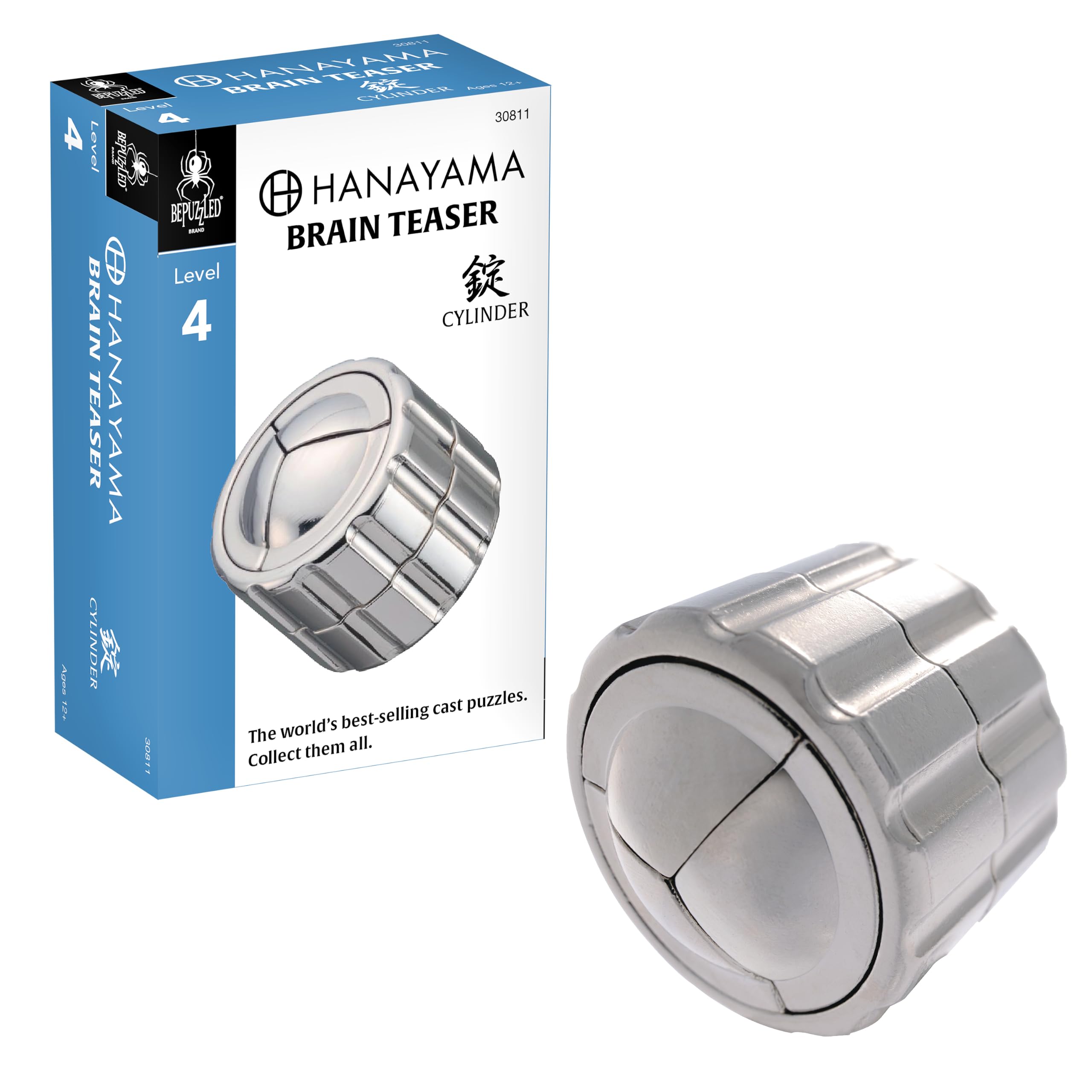
Hanayama Cylinder

Hanayama Cylinder

Desk challenge

Doodle Score 9.6/10
Check Price

Worth Noting

  • One solution, so replay is limited
  • Can be forced apart if handled roughly
Material
Cast metal
Puzzle Type
Disentanglement
Difficulty Level
4 (challenging)
Manufacturer Age
12 years and up
Read the full review

The Cylinder arrives as a solid green metal object with no seam that explains itself and no printed clue beyond the goal: separate it into its parts, then put it back together. We spent a good while just turning it over before anything moved, which is the right way for a disentanglement puzzle to begin.

Hanayama rates it level four of six — challenging rather than punishing — which makes it the metal puzzle we hand to someone who has never done one. The mechanism gives small signs of progress instead of staying silent for an hour, so a first-timer gets the satisfaction of feeling the thing begin to give.

Getting it apart is the short half. Getting it back together is where the evening goes, and it is genuinely harder than the way in — that's the design working, not a fault, but plan for it. It's also not a lock. Force it and it comes apart before you've found the mechanism, and the trick is spent; this is a puzzle to turn over patiently rather than wrestle.

As an object it earns its place on a desk: cast metal, real weight, a finish that looks better than the shelf it sits on. As a puzzle it offers a single solution, so the value sits in the first evening and the occasional proud re-solve. That's the trade against a card-based set — one beautiful problem instead of hundreds of paper ones.

Bottom line: For a solver who wants one elegant object and a hard evening, this is the metal puzzle to start with: level four, no clues, satisfying to rebuild.

#3

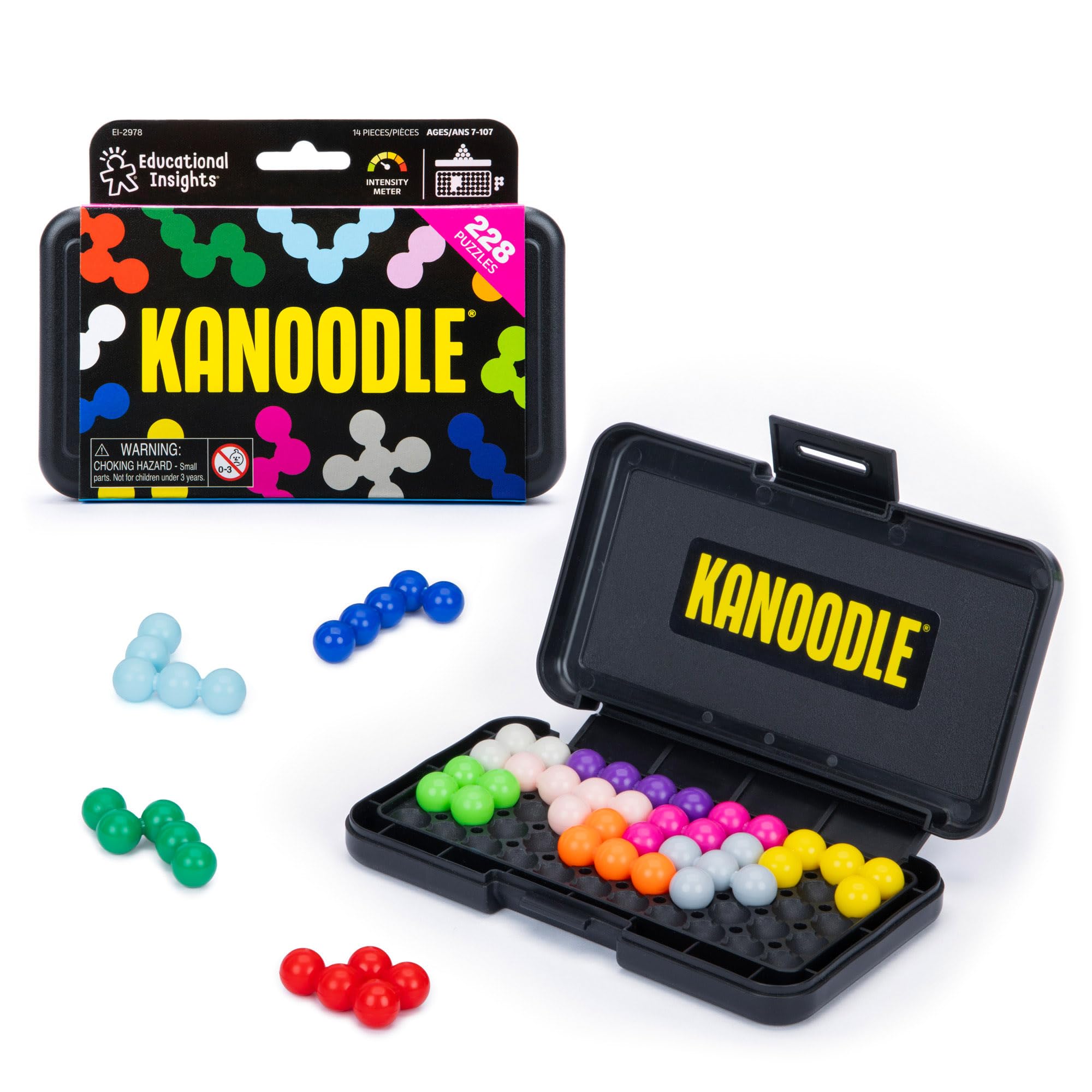
Educational Insights Kanoodle

Educational Insights Kanoodle

Travel and solo

Doodle Score 9.4/10
Check Price

Worth Noting

  • Solo play only, with no second-player option
Players
1
Challenges
228, 2D and 3D
Packed Size
5.75 x 3.25 x 0.75 in
Manufacturer Age
7 years and up
Read the full review

The reason Kanoodle holds the top spot is the ladder, not the pieces. There are 228 challenges in the little case, and they begin with a shape most seven-year-olds will finish before you've read the guide, then climb into 3D builds that stop adults cold. That range is exactly what we want from a brain teaser: something a child can start alone and a grown-up can still lose to.

The case is the design decision we appreciate most. It holds all twelve pieces and the challenge guide, doubles as the board, and snaps shut, so nothing is rolling around loose in a bag. At 5.75 by 3.25 by 0.75 inches and about three ounces, it disappears into a jacket pocket, and of everything here it's the one happiest on a train tray table.

The on-ramp is the weak part. The first handful of puzzles are easy enough that an older child will clear them in one sitting, which makes the set look like a preschool toy on first acquaintance. Push past the first dozen and the 3D pyramid challenges change the tone completely — that's where the spatial work happens, and where we stopped being able to solve one while talking.

Set against Gravity Maze, this is the quieter, smaller option that never needs a table edge to keep a marble contained. Set against the Genius Square, it gives up the head-to-head race but adds hundreds of solo challenges. For one purchase that covers the widest age range in a house, this is the one we reach for.

Bottom line: This is the one we recommend to almost every household: a seven-year-old and an adult can both work through it, and the final third is genuinely hard.

#4

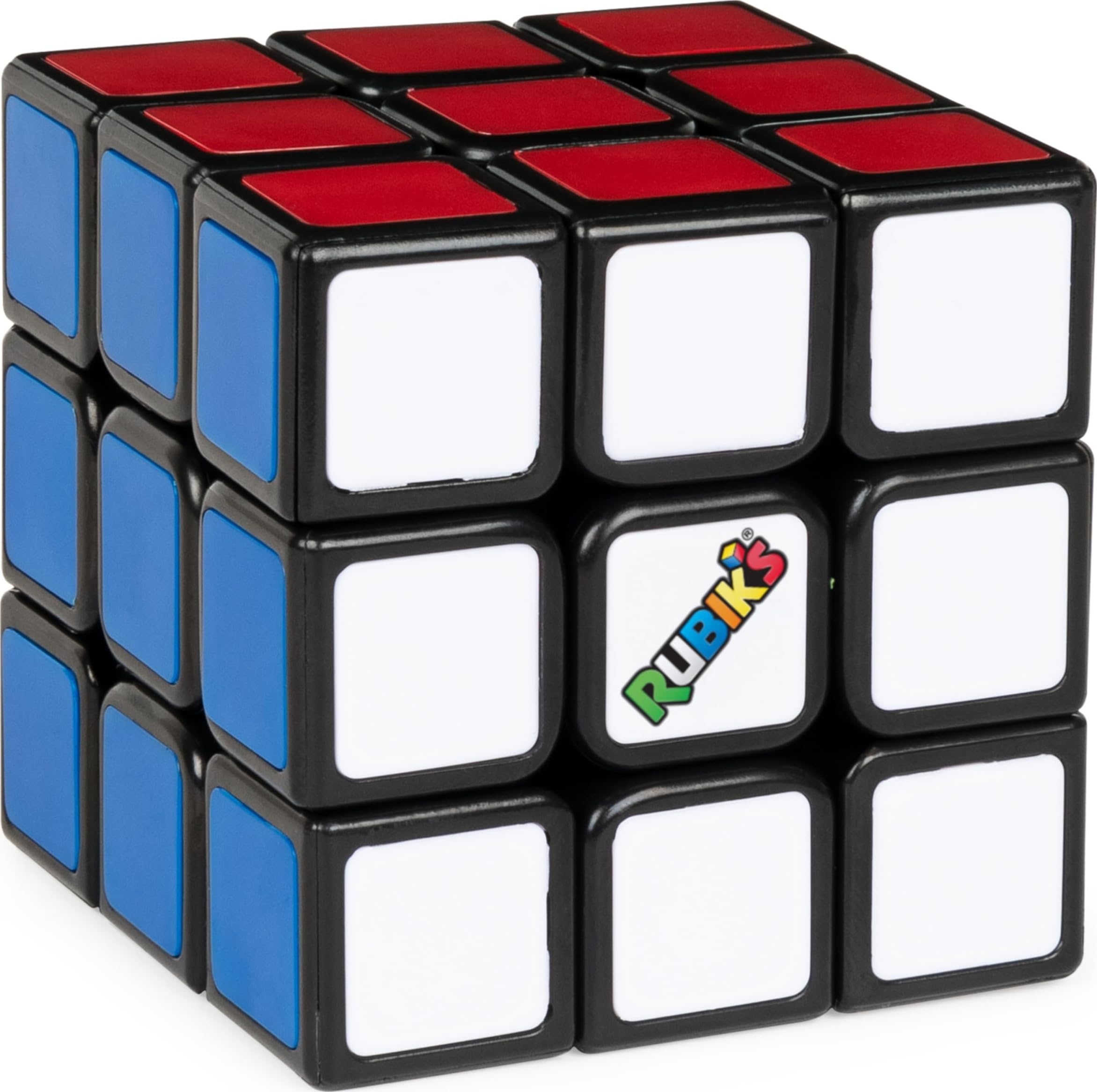
Rubik's Cube 3x3

Rubik's Cube 3x3

Long-term practice

Doodle Score 9.4/10
Check Price

Worth Noting

  • Turn quality varies between cubes
Format
3x3 twisty
Players
1
Material
100% recycled plastic
Manufacturer Age
8 years and up
Read the full review

This is the only puzzle here that doesn't hand you a card and tell you when you're finished. Six sides, one solved state, and no instructions beyond the cube itself — you need a method from somewhere, and learning one is the actual hobby. We like it for that: it turns into a skill you can feel getting better, rather than a set of challenges you complete and put away.

The mechanism is where these vary, and it's worth knowing before you buy. A good unit turns a face with a light click and holds the position you left it in. A loose one overshoots and jams against the next layer, which is maddening in a way that has nothing to do with how well you're solving. Ours arrived clean and stayed that way through a lot of idle twisting, and the recycled plastic has a pleasant matte feel. It's also the second-most portable thing on this list, with nothing to lose.

Bottom line: For a solver who wants one skill to chip at over weeks instead of a stack of cards finished in an evening, this is still the standard.

#5

Coogam Wooden Blocks Puzzle

Coogam Wooden Blocks Puzzle

Younger builders

Doodle Score 9.4/10
Check Price

Worth Noting

  • No bag, lid, or tray for the blocks
Board
7 x 10.6 in
Pieces
40 wooden blocks
Players
1
Material
Basswood
Read the full review

This is the least expensive way into the category, and it hands you the most objects for it: forty basswood blocks and a board about seven by eleven inches, along with a sheet of example shapes to copy.

The wood is why it earns a place. The blocks are smooth and light, they settle into the board with a satisfying click, and the colors are bright without tipping into garish. It's also genuinely open-ended in a way a card-based set isn't — you can copy a picture, fill the whole board, or build a shape nobody drew. Ours has been tipped onto a floor and survived, though the board itself is thin and we wouldn't call it rugged.

What it isn't is a ladder. There's no puzzle 47 to beat, just pictures to match, which suits a five-year-old and a grandparent equally and leaves an eight-year-old wanting the structure of a Kanoodle. If the household solver is already past easy shapes, spend the extra on a set with numbered challenges.

Bottom line: The one we point to when a five-year-old and a grandparent want to share a puzzle on the floor on a small budget.

#6

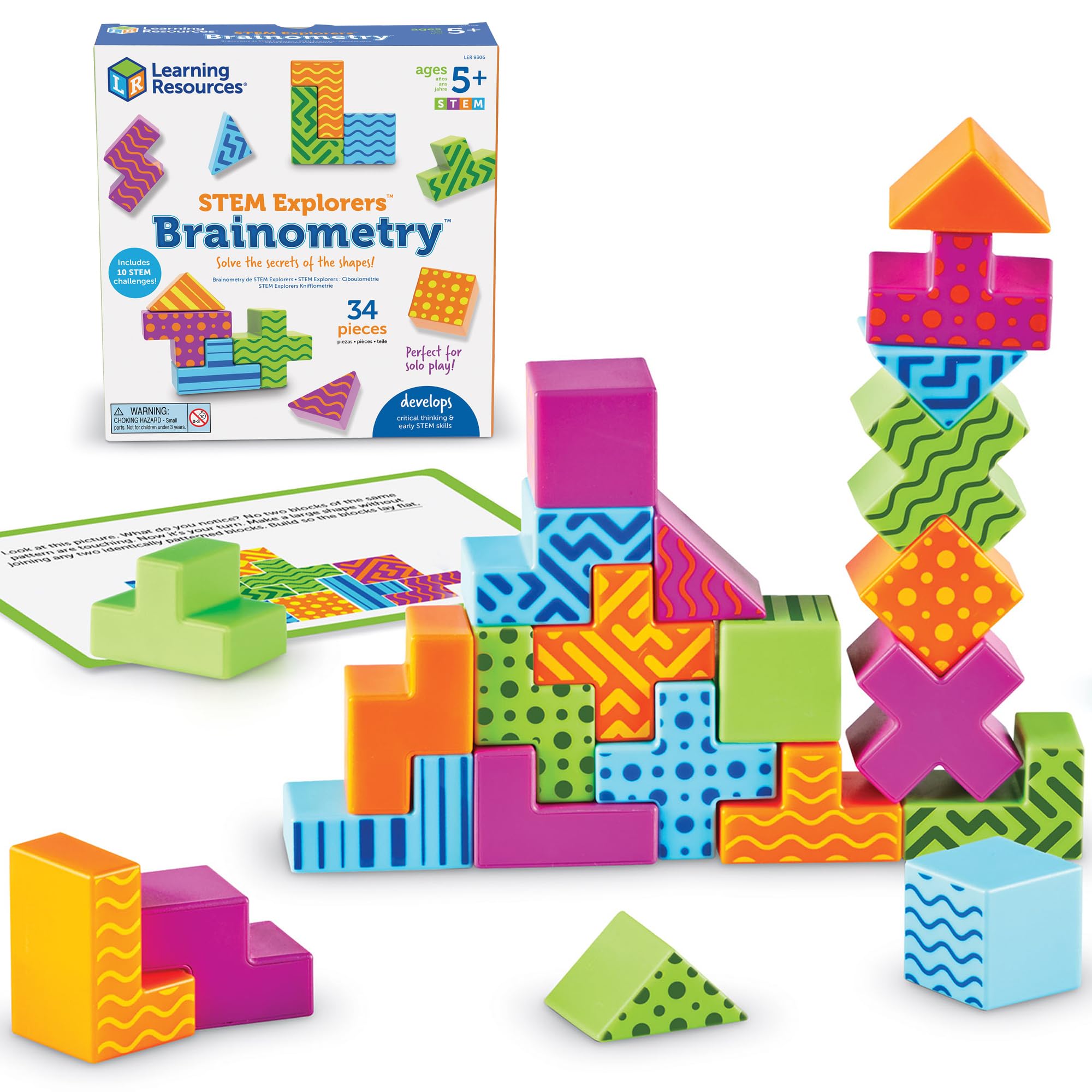
Learning Resources Brainometry

Learning Resources Brainometry

Youngest solvers

Doodle Score 9.4/10
Check Price

Worth Noting

  • Pieces are smaller than the photos suggest
Pieces
34 pieces
Players
1
Challenges
10 double-sided cards
Manufacturer Age
5 to 10 years
Read the full review

This is the one to buy when the household solver is five. Brainometry is 34 plastic pieces, ten double-sided challenge cards, and a storage box, and the job is simple: match the pattern on the card with the blocks. No reading, no rules, and a finished picture at the end of each attempt.

The pieces are smaller than the product photos suggest, and they're light, so a structure built on a coffee table will topple when a small hand nudges it. That matters less at this age than it sounds — rebuilding is most of the game — and the box means all 34 pieces go back into one place, which counts for more than any feature printed on a card.

Twenty challenges is a short runway. A six-year-old will finish the cards, and after that it's free building or nothing, which is the point where Kanoodle takes over with far more puzzles and a longer climb. As a first real puzzle for a five-year-old, though, the length is about right, and the shapes are forgiving enough that the first few cards end in a finished picture rather than a shrug.

Bottom line: Buy it for a five- or six-year-old who wants to do what the older kids are doing; the cards tell them exactly what to build.

#7

ThinkFun Gravity Maze

ThinkFun Gravity Maze

Building and logic

Doodle Score 9.2/10
Check Price

Worth Noting

  • Needs a whole table to itself
  • Marbles are easy to lose
Players
1
Challenges
60 cards, beginner to expert
Components
9 towers, 3 marbles
Manufacturer Age
8 to 15 years
Read the full review

The payoff in Gravity Maze is audible. The marble drops through the tower you placed, runs down the grid, and lands in the target with a clack — and that sound is what turns a challenge card from a worksheet into a design brief.

Each card shows where a few towers must sit and where the marble has to end up; the rest is yours. With 60 cards, 9 towers, and 3 marbles, the climb is real. The early cards take a minute, and the later ones had us re-planning three towers deep after the obvious route failed. It sets up on a table rather than a lap: the grid runs roughly nine by ten inches, and a marble that misses finds the floor.

What we came away liking most is how visible the thinking is. Nothing is hidden — a wrong route is a marble stuck at a gap you can see — so a child learns to plan instead of guess, and an adult gets to watch a plan fail in real time. It's the pick for a builder rather than a word-puzzle person, and the one to buy if the reward needs to be physical.

Bottom line: Buy it for the child who wants to build something and watch it work — 60 cards, a marble payoff, and a top end that stops adults.

How We Tested, Timed, and Occasionally Broke 14 Brain Teasers

We started by gathering everything with a real mechanism behind it rather than a novelty shape, then filtered by materials, price, and whether owner reviews mentioned pieces seizing up or joints failing. Anything that could be solved once and not reset got cut, as did the ones whose only challenge was decoding the instructions. That left 14 puzzles, and each spent four months in rotation.

They lived where these things actually live — a coffee table, a kitchen counter, a hotel nightstand — used while pasta water boils, during the lull at a dinner party, on a long flight. We timed everyone's first attempt, then handed the same puzzle back a week later to see whether the solution had stuck. Each one also went to a nine-year-old, a teenager, a forty-something, and my father-in-law, who solves most of these in a single sitting, so we could see where the difficulty actually landed. And we noted how fast people understood what was being asked — free the ring, split the halves — because a puzzle nobody understands isn't hard, it's just badly made.

Maneuverability came down to whether the pieces slid without grit, whether you could hold it comfortably while thinking, and whether the solve required three hands. For durability, we dropped each one onto tile from counter height and carried it loose in a tote bag beside keys; two came back rattling and a rope version frayed. Assembly got its own check — could it be taken apart and reset without the diagram — and since so many of these are bought as gifts, we looked at the box, the instructions, and whether it looked worth handing to someone.

How to Choose Brain Teaser Puzzles

Read the challenge ladder, not the piece count

A set with 228 graded challenges and a set with one solution are different purchases wearing similar packaging. Card-based puzzles — Kanoodle, Gravity Maze, the Genius Square — hand you a finite stack of problems. A cast-metal disentanglement puzzle gives you exactly one. Neither is better, but only one of them will still be interesting next month.

Difficulty labels also don't transfer between brands: a Kanoodle expert card and a Hanayama level four have nothing in common but the word challenging. The check that works is to find the easiest puzzle in the set and ask whether the youngest solver can finish it, then find the hardest and ask whether the oldest will be stuck. If either answer is no, the set gets abandoned at one end or the other.

Decide whether you want a game or a puzzle

How many people will actually sit with it? The Genius Square ships with two grids and two sets of pieces so a second player can race the same roll, and Gravity Maze is a solo build that children often end up doing shoulder to shoulder. Everything else here is one person and one set of hands.

If the puzzle is going to become a shared after-dinner activity, buy the one with two grids. If it's for a commute, a waiting room, or ten minutes before bed, buy the one that fits a pocket and doesn't need a second person to be worth opening.

Where it lives decides what it has to hold

Pieces are the thing you lose, so look at what contains them. Kanoodle's case holds all twelve pieces and doubles as the board, and Brainometry's box keeps 34 blocks together. The Genius Square is compact but depends on its box to stay complete, and a forty-block wooden set with no bag ends up loose in a drawer.

The trap is reading compact as packable. A listing can describe a small board while the parts inside it are loose and countable, and a marble run is only tidy until someone tilts the table. If the puzzle is going to travel, count the parts that would scatter — and leave anything with marbles at home.

Material and format decide whether you can solve it twice

Metal puzzles are the most satisfying thing to hand someone and the least replayable. Once the Cylinder comes apart, it becomes a desk object with a story. Wooden tangram sets are the opposite: no numbered answers, so the play stays open-ended and lasts as long as the pieces do. Plastic card-based sets sit in the middle, with a fixed number of graded puzzles and a clear finish line.

Buy metal for one person who wants a hard evening and something to leave on a desk. Buy a card-based set for a family that will work through it together, and buy wood when the point is building rather than beating anything.

Frequently Asked Questions

Final Verdict

Kanoodle is the one we recommend to almost every household. Two hundred twenty-eight challenges in a case that fits a coat pocket, a ramp that starts with a seven-year-old and ends somewhere past most adults, and a price that makes it an easy birthday answer. If you buy one puzzle from this list, buy that one.

Change the recommendation when the requirement changes. If the puzzle is going to be a shared activity, the Genius Square turns the same idea into a race and is the better buy for two competitive people. If you want one hard, beautiful object rather than a stack of cards, put the Hanayama Cylinder on the desk instead.