Baby & Toddler

Best Teaching Clocks for Kids of 2026

A teaching clock has one job: turn "the big hand is on the 3" into "it's quarter past" without a worksheet in sight. The trouble is that plenty of them are toys first and clocks second — hands you have to nudge separately, gears that grind, faces so crowded with animals and rainbow stickers that the numerals disappear. I've watched a kid lose interest in exactly that order, usually somewhere around day three.

What a good one does is simpler than it sounds. It moves its hands the way a real clock does, so turning the minute hand drags the hour hand along with it, and it keeps a face clear enough to read from across the kitchen. My team and I have had 14 of them in rotation for the past four months, on the playroom floor and on the table during the before-school scramble, and the ones that stuck were the ones that behaved like actual clocks — price turned out to be a shaky predictor of that.

#1

Learning Resources Time Activity Set
Learning Resources Time Activity Set

Home practice

Doodle Score 9.6/10
Check Price

Worth Noting

  • Hour hand cannot be set on its own
  • Cards say 00 where the dial says 60
Ages
5 - 8 years
Hands
Linked hour and minute
Players
1-4
Includes
Clock, write-and-wipe clock, cards, dice, puzzles, guide
Read the full review

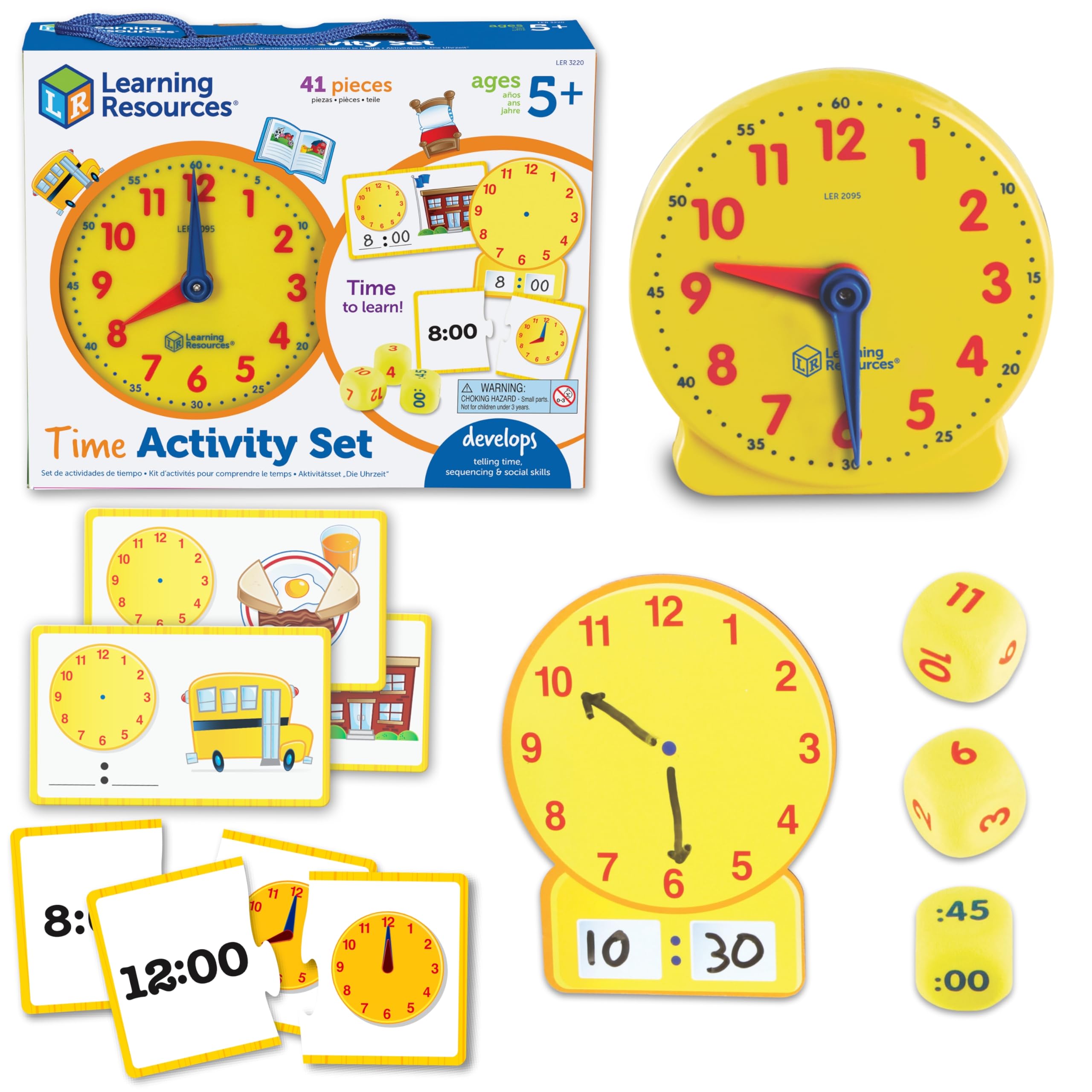
The box is the argument here. Along with the teaching clock you get a second write-and-wipe clock face, double-sided activity cards, two dice, a small puzzle, and a guide full of lesson ideas, so the same skill gets approached four or five ways at once. That matters more than it sounds: the child who ignores the cards will happily throw the dice, and the lesson keeps going.

The clock itself is why this is our top pick. Turn the minute hand and the hour hand travels with it, one minute at a time, the way a real movement behaves. Crank it twice around and the hour hand walks from 3 to 5, and the relationship lands without anyone explaining it. That linkage is also the thing to know before you buy: the hour hand cannot be parked on its own, so setting 3:45 means winding round from twelve, and a child who tries to force it will feel the resistance. Practice runs from the minute hand instead.

One detail cost us a few minutes of explaining. The cards and dice write the top of the hour as 00, while the clock face finishes its minute ring at 60. It is a short conversation and a genuinely useful one, because hearing that the same moment has two names is exactly the confusion a six-year-old needs to have out loud.

Rated for 5 to 8 and playable with up to four children, it is the set we reach for when a child can count but stalls at quarter to. The little puzzle was the surprise of the box: it turned a time question into something with a right answer you can hold, and it pulled our youngest back to the table without being asked.

Bottom line: Our pick for most families: a clock to handle, cards and dice to work through, and a wipe-clean face for digital practice, all for less than most of the wall clocks here.
#2

OWLCONIC Kids Wall Clock

OWLCONIC Kids Wall Clock

Classroom and bedroom

Doodle Score 9.6/10
Check Price

Worth Noting

  • Wall-mounted, so hands cannot be handled
Ages
4 - 18 years
Battery
1 AA, screw-secured cover
Movement
Silent quartz sweep
Face Size
10 inches
Read the full review

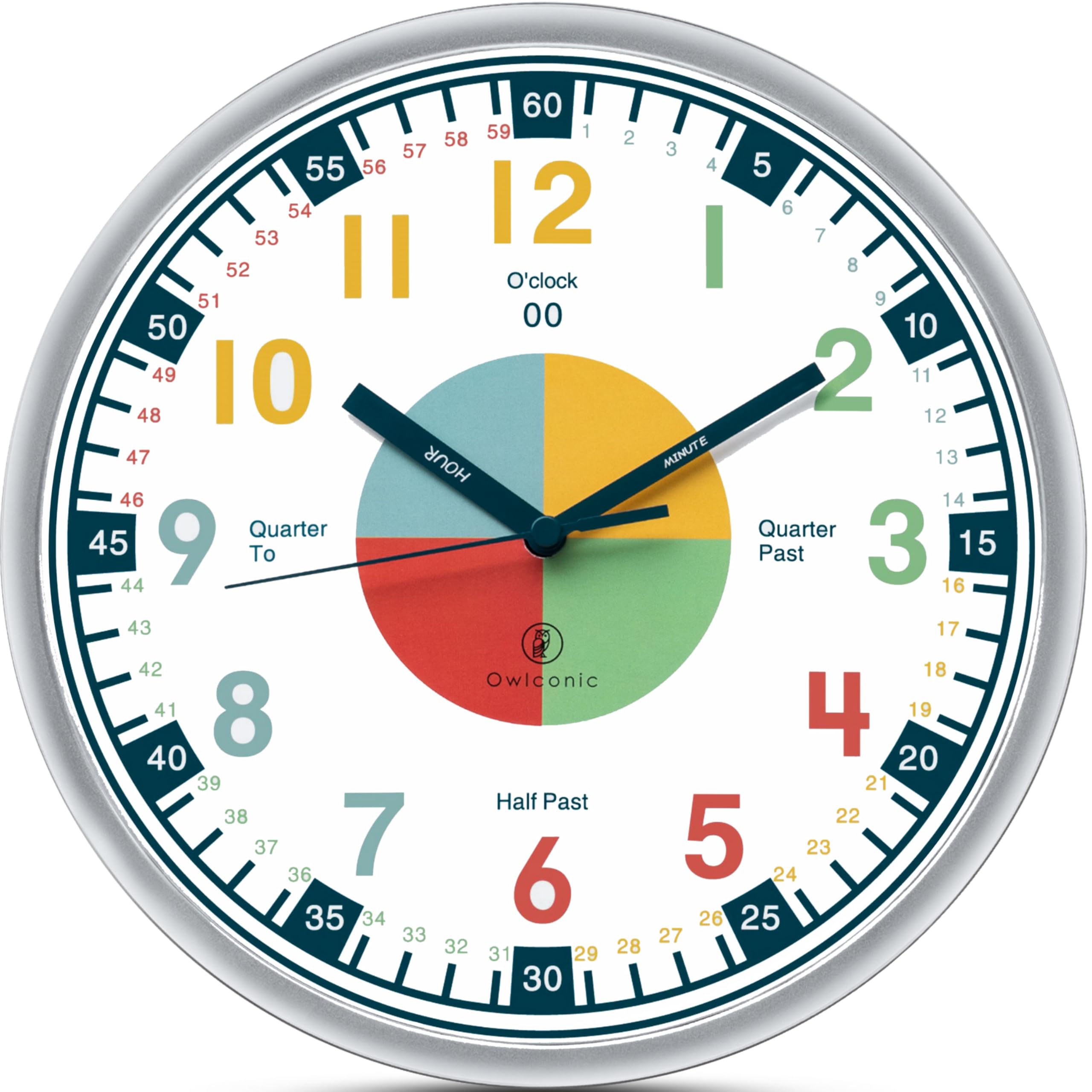
At ten inches across, this ties for the largest face in our wall-clock group, and the size is doing real work. It is the difference between a child pointing confidently at the minute hand and squinting from the kitchen table to work out which hand is which.

The labeling carries the rest. Every minute is numbered rather than only the twelve hours, the hands are printed with the words HOUR and MINUTE, and the quarters are spelled out: quarter past, half past, quarter to. The first time we hung it, a child who had been guessing started reading the minute hand properly, because there was nothing left to work out. The sweep second hand is silent, which is why this one ends up in bedrooms and classrooms rather than hallways.

It is a wall clock, and that is the boundary. You cannot take it down and move the hands with a child, so it works as the reference after the lesson rather than as the lesson. Pair it with something to handle for a beginner; buy it alone for a child who mostly needs practice. Two details we appreciated: a battery cover secured with a screw, and an acrylic face that keeps the whole thing light enough to hang on one nail in a kid's room.

Bottom line: Buy this one when the teaching has to happen on the wall: every minute numbered, both hands labeled, and nothing ticking through a bedtime.

#3

Melissa & Doug Shape Sorting Clock

Melissa & Doug Shape Sorting Clock

Toddlers and preschoolers

Doodle Score 9.6/10
Check Price

Worth Noting

  • Number pieces can chip with rough play
Ages
3+ years
Size
9.0 x 9.0 x 4.5 inches
Hands
Rotating hour and minute
Pieces
12 removable numbered shapes
Read the full review

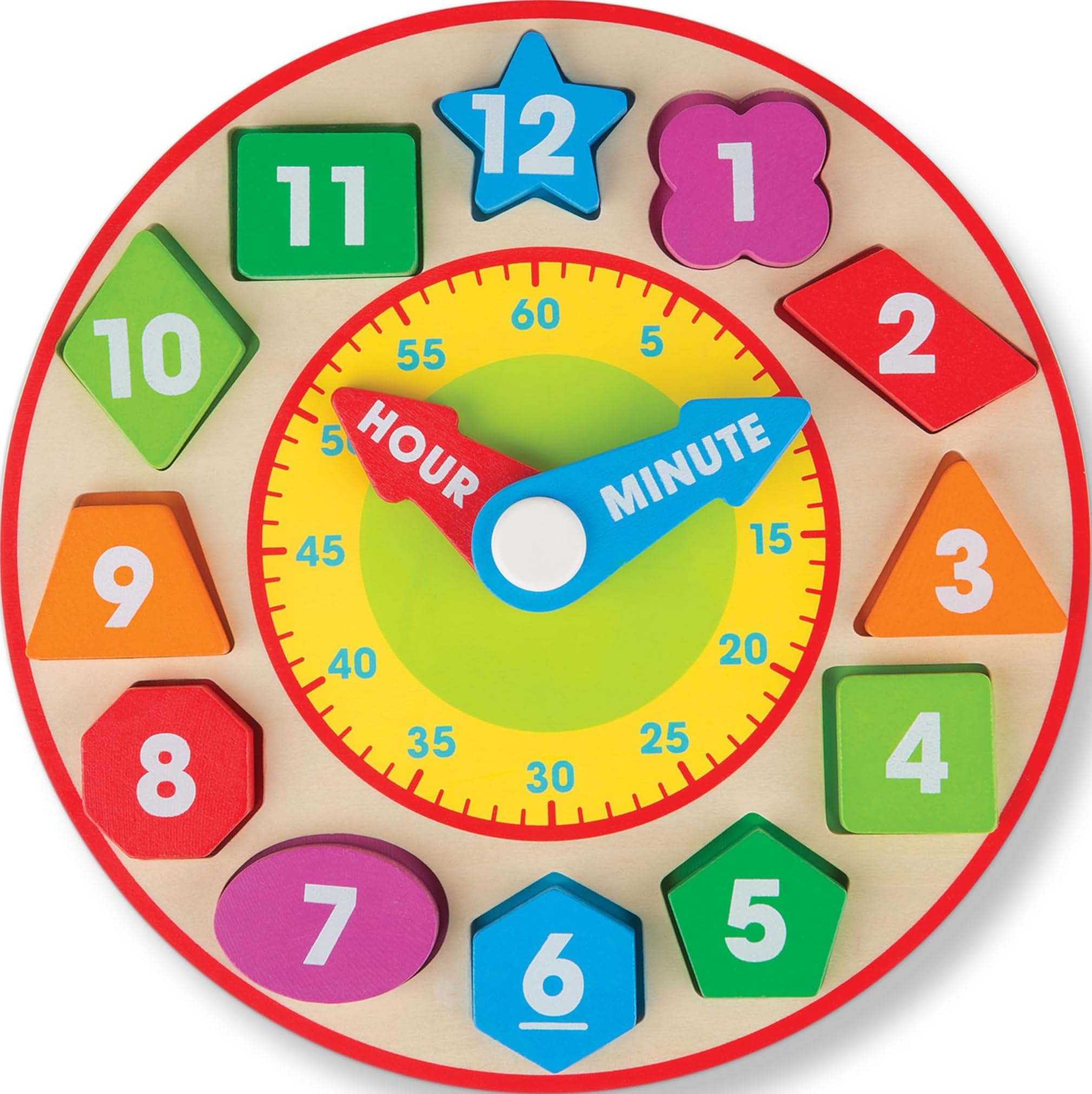
A three-year-old cannot tell time, and this clock does not ask them to. What it asks is that they fit twelve chunky numbered shapes into twelve recessed wells, which is number recognition, shape matching, color, and a fine-motor task in one go. That is why it is our pick for the under-fives rather than a clock they cannot use yet.

Both hands rotate, and they are different colors, so hour hand and minute hand can become household words long before the reading does. We like that ordering. A child who has handled the pieces a hundred times already knows where the 7 lives and what it looks like, and that is half of clock reading solved before the lesson starts.

Build is the caveat. The pieces are chunky and the colors hold, but a determined chewer or a hard kitchen floor can chip an edge, and that is the only wear we would flag. The shapes do not name themselves either, so the words are your job, which is fine, since this is a toy you are meant to sit down with anyway.

Bottom line: For a two- or three-year-old, start here rather than with a time lesson: numbers, shapes, and colors now, with movable hands waiting for later.

#4

Roymnie Kids Learning Clock

Roymnie Kids Learning Clock

Small wall spaces

Doodle Score 9.4/10
Check Price

Worth Noting

  • 8-inch face reads small across a room
Dial
Color-coded hours, numbered minutes
Size
8 inches
Battery
1 AA
Movement
Silent quartz sweep
Read the full review

The cheapest wall clock in this group, and it asks the least of you: one AA battery, one nail, done. At eight inches it is a bedroom or kitchen-door clock rather than a living-room one, and the face does more than most at that size. Each hour sits in its own color, every minute is numbered, and the words quarter past, half past, and quarter to are printed right on the dial.

The hands are labeled as well, and the sweep movement is silent enough that we forgot it was running. For a child who is nearly there, who knows the hours and still guesses at the minutes, the printed ring does the same work as the color coding on the pricier wall clocks, for a fraction of the price. Nothing about it feels like classroom equipment.

Our judgement is that this is a good first wall clock and a poor only wall clock. At eight inches it is small from across a room, so it wants to hang at a child's eye level somewhere they pass every day: a bedroom doorframe, the end of a kitchen counter, the side of a bunk. That is a placement decision rather than a fault, but it does mean this will not take over from the family clock.

Bottom line: Our budget wall clock: labeled minutes, printed quarter-past wording, and a silent movement for a fraction of what the big teaching clocks cost.

#5

Oyster&Pop Kids Wall Clock

Oyster&Pop Kids Wall Clock

Family rooms

Doodle Score 9.4/10
Check Price

Worth Noting

  • Movement has failed within the first month for some
Ages
4 - 12 years
Includes
Printable activity e-book
Movement
Silent sweep
Face Size
10 inches
Read the full review

Hang this one in a hallway and it reads as a clock rather than a teaching aid. The wood-effect frame and the multicolored dial make it the closest thing here to something you would have bought anyway, which matters if the alternative is a learning clock that gets relegated to a playroom.

Underneath the finish, the teaching is thorough. Every minute is numbered, the hour and minute hands are labeled and color-coded, the quarters are marked, and the movement is a silent sweep. At ten inches it holds up at the distance a child actually reads from, and the activity book that comes with it is a printable download rather than a booklet, so budget for a few pages of printing.

It is the pick a child will not outgrow into embarrassment: an eight-year-old will still leave this on the wall, which is more than most learning clocks manage. Know what the frame is before you order, though. It is a wood-effect finish over a plastic case, which is what keeps a ten-inch clock light enough to hang just about anywhere.

Bottom line: Choose it if the clock has to look like decor: it teaches properly, and an eight-year-old will still be happy to have it on the wall.

#6

Learning Resources Write & Wipe Clock

Learning Resources Write & Wipe Clock

Group demonstration

Doodle Score 9.2/10
Check Price

Worth Noting

  • Thin hands can be stiff or loose
Type
Manual demonstration board
Surface
Write-and-wipe dry erase
Mounting
Tabletop stand
Face Size
12 inches
Read the full review

This is not a clock, and that is the point. You get a twelve-inch face with movable hands, a strip above it you write on with a dry-erase marker, and a stand that lets it sit on a table. There is no movement, no battery, and nothing that keeps time. What it does is put the analog face and the digital answer side by side, which is the exact conversion children stumble over, and that is the most useful thing a teaching clock can do in a room full of kids.

For a classroom, a co-op, or a kitchen table with two or three children around it, the writing space is worth more than any feature on the other clocks here. You set the hands, a child writes 7:45 in the strip, you wipe it and go again. It does the job of the cards in our top pick without any pieces to lose, and the twelve-inch face is readable from the back of a small room.

The hands are the weak point. They are thin, and depending on the unit they arrive either stiff enough that an adult has to do the turning or loose enough to swing while a child writes. Neither ruins a lesson, but plan on setting the time yourself and letting the children do the reading and the writing. It is also a table tool rather than a floor toy, so keep it somewhere it will not be stepped on.

Bottom line: We recommend it to anyone teaching a group or working through analog-to-digital conversions, where a big wipe-clean face beats a battery movement.

#7

BEST LEARNING Talking Clock

BEST LEARNING Talking Clock

Independent practice

Doodle Score 9.0/10
Check Price

Worth Noting

  • Hour hand can stop clicking into position
  • Small dial at about six inches
Ages
3 - 6 years
Size
5.98 x 4.33 x 5.91 inches
Modes
Time, quiz, sleep
Batteries
3 AAA included
Read the full review

Set a time with the hands, press the button, and a voice reads it back, first the simple version and then the advanced one. That second reading earns its place: it is the difference between seven forty-five and a quarter to eight, and it is the piece most clocks leave the parent to supply.

Quiz mode flips it around. The clock asks for a time, your child moves the hands to answer, a green light confirms it, and a wrong answer gets three patient tries before the clock moves on. We have met quiz toys that buzz at a wrong answer and lose the child in the process; the retries here are what make this something a five-year-old can use alone.

It also earns a second life at bedtime. Twelve glow colors, ten lullabies, and a sixty-minute fade-out timer mean it stays on the shelf after the quiz stops being novel, and the two volume levels go quiet enough for a shared room. Very few teaching gadgets survive the week a child learns the trick; this one turns into a night light.

The reservation is the mechanism behind the quiz. The hour hand has to click into a position for the clock to know what time is set, and once that clicking stops, the quiz is asking a question it can no longer mark. Give the hour hand a full sweep in the first week. The dial is also small at roughly six inches, so this is a hold-it clock for a lap or a car seat rather than something you hang, and for a child who wants to hear the answer before they can read it, that is a fair trade.

Bottom line: The pick for a child who learns by listening: it says the time, quizzes gently, and then earns its keep as a night light.

How We Chose and Tested the Best Teaching Clocks

I started with a list of roughly 40 clocks pulled from teacher-supply catalogs, manufacturer spec sheets, and the toy aisles I keep wandering down. To make the shortlist, I read the box for the age range and checked whether the hands were geared together or moved independently, whether the face leaned on a digital readout, and what each one cost relative to what it did. That left 14 clocks, which my team and I kept in use for four months.

Most of the testing happened where clocks actually get used: the kitchen table during the before-school countdown, the playroom floor, and the bedside table at bedtime. I turned each minute hand through twelve full circles and watched whether the hour hand landed squarely on every numeral, then gave each clock a gentle shake to see if the hands drifted on their own. Every clock was set to the same time and checked against a phone every two weeks, which is how we caught the one that quietly lost eight minutes.

Then the kids took over. I handed each clock to 4-, 6-, and 8-year-olds with no instructions and watched which ones they picked up again a week later — that was our real playability test. Clocks got dropped from a three-foot table onto hardwood and wiped with a damp cloth to see how the plastic and the printed faces held up. For readability, I stood across the room and asked a child to read the time aloud; contrast and color mattered far more there than the size of the numerals.

How to Choose Teaching Clocks for Kids

Start with what your child can already do

Buy for the stage, not the age printed on the box. A two- or three-year-old gets numbers, shapes, and colors from a clock long before time means anything, which is what the Melissa & Doug shape sorter is for. A four- to six-year-old is ready for the analog dial itself, and wants a face where each hand is named and the minutes are numbered. Past seven, the useful purchase is a wall clock at eye level, because the skill now lives in daily life.

One readiness check does more than any age guide: if your child can count to 60 by fives, they are ready for the minute hand. If not, stay on the hour hand and on where it points at o'clock.

The minute ring does the teaching

A face with twelve numerals and two similar hands asks a child to count and to guess. The faces that teach carry more: a numbered or five-minute-marked ring all the way round, the words HOUR and MINUTE printed on the hands, and quarter past, half past, quarter to spelled out. The OWLCONIC adds a color per hour zone, which helps a beginner keep the hours straight before the minutes make sense.

That is the trap to avoid. A pretty clock with no minute ring is decor, and a child reading it is guessing at the minutes and getting away with it half the time.

Geared hands or hands you set yourself

Some teaching clocks link the hands: turn the minute hand and the hour hand creeps forward the way a real movement does. That linkage is the clearest demonstration of passing time you can put in a child's hands, but it means the hour hand cannot be parked on its own, so 7:40 gets set by winding round from twelve. Independent hands let you pose any time instantly, which is better for drilling and teaches nothing about how the two hands relate.

For a beginner, take the linked hands. For a child who understands the relationship and needs reps on 'show me quarter to,' take the independent ones.

Wall clock, tabletop, or something to hold

A manipulative is a lesson; a wall clock is a reference. Most families end up with both, and the order matters: handle a clock together first, then hang one where the child actually looks. Height decides more than width. An eight-inch clock at a child's eye level teaches more than a ten-inch one hung at adult height, and a ten-inch face is only worth paying for if it is going somewhere it will be read from across a room.

Give the movement a week before you hang it

Nearly every clock here runs on a single AA and a cheap quartz movement, and the movement is the part that fails. When a unit is going to fail it usually does so early, so run a new clock for a week before it goes on the wall and keep the receipt until the week is up. In a house with toddlers, check that the battery cover is screw-secured rather than a snap-off lid, and hang it high enough that the lid is out of reach.

Frequently Asked Questions

Final Verdict

Buy the Learning Resources Time Activity Set if you are teaching a five- to eight-year-old from scratch. It is the only pick here that gives you a clock to handle, cards and dice to work through, and a wipe-clean face for the digital side, and it costs less than the wall clocks on this page.

If your child already reads the hours and stalls on the minutes, hang the OWLCONIC at their eye level instead and keep the set for practice sessions. The full minute ring is what unsticks that particular child, and a clock they walk past fifty times a day does the repetition for you.