Arts & Crafts

Best Craft Kits for Kids of 2026

A craft kit is supposed to buy you a quiet afternoon and a fridge-worthy masterpiece. Too often it buys you twenty minutes of whining, glue that never sets, and pieces too tiny for the age on the label. The real test is whether it holds a kid's attention long enough to finish—and whether the finished project survives the trip to the wall. That's what a good kit fixes: it turns a restless hour into something they're proud of, without you having to improvise supplies or referee a glue crisis.

We've spent three months testing 14 craft kits with kids from preschool to second grade—some as birthday gifts, some on rainy Saturdays. The ones that work share a few unglamorous traits: they include everything you need, they hold up to being shoved back in the box between sessions, and their glow-in-the-dark stickers actually glow. A kit that costs a little more but delivers three afternoons of engagement is a better value than a cheap one abandoned by lunch. Below are the ones that earned a spot on our shelf.

#1

Crayola Inspiration Art Case

Crayola Inspiration Art Case

Most families

Doodle Score 9.6/10
Check Price

Worth Noting

  • Case and trays can crack with rough handling
Pieces
140
Case Size
15.63 x 11.63 x 2.04 in
What's Inside
Markers, crayons, colored pencils, paper
Recommended Age
5 and up
Read the full review

The Inspiration Art Case is not a glue-and-build craft kit, and that is the first thing to say about it. Open the tie-dye case and you get 40 washable markers, 64 crayons, 20 short colored pencils and 15 sheets of paper in molded trays. No glitter, no pom poms, nothing to assemble.

That narrowness is exactly why it earns the top spot here. Drawing is the craft most kids come back to without being asked, and this set removes every reason not to start: no drying time, no adult setup, no glue to unblock. The trays hold markers, crayons and pencils in separate channels, which matters more than it sounds — a 140-piece set with no dividers becomes a heap by the second week.

The case measures 15.63 by 11.63 by 2.04 inches and weighs about a kilogram, so a child can carry it by the handle to the car, a waiting room or a grandparent's kitchen. Washable markers are the right call for that kind of traveling, and the paper, at roughly 9 by 13 inches, is big enough for a proper drawing and small enough to finish in one go.

Where it stops being the answer is the child who wants to cut, glue and build — that kid needs the Dan&Darci Vault, not more crayons. For everyone else this is the kit that gets used on a rainy Tuesday rather than saved for an occasion. The 15 sheets are the shortest-lived part; the supplies outlast them, and a stack of copy paper keeps the case working for years.

Bottom line: Our pick for most families: a complete drawing set in one case that a five-year-old can open, use and pack away without an adult.

#2

Dan&Darci Arts and Crafts Vault

Dan&Darci Arts and Crafts Vault

Open-ended making

Doodle Score 9.6/10
Check Price

Worth Noting

  • Priciest kit in this group
Pieces
1,000
Storage
Two-drawer case with dividers
Recommended Age
4 to 12
Read the full review

The Vault is the most expensive kit in this guide, and it is the one we point to when nobody knows what a child wants to make. A thousand pieces fill two drawers: pipe cleaners, pom poms, wooden discs and beads, felt strips, craft sticks, sequins, sticky gems, googly eyes, feathers, buttons and thread.

The drawers are the underrated part. Craft supplies in a shoebox turn into a tangle of pipe cleaners within a week, and this case keeps categories apart so a seven-year-old can find the googly eyes without tipping everything onto the floor. It also covers the widest age spread here — four to twelve — because nothing in it dictates a result. A four-year-old glues pom poms to a wooden disc; a ten-year-old builds a wind chime.

Two things to know before you hand it over. The box contains sewing needles and scissors, which puts it firmly in supervision territory at the youngest end of that range. And the glue is the weak item; a bottle of school glue from the kitchen drawer fixes most of it, and the heavier pieces need it. This is a supply box, not a project box — there are no instructions, so it rewards a child with ideas and stalls one who wants to be told what to make. For that child, the glow rock kit goes further.

Bottom line: We recommend it for the child who invents projects rather than follows them — a thousand supplies in drawers that survive repeat sessions.

#3

Play-Doh Starter Set

Play-Doh Starter Set

First craft kit

Doodle Score 9.6/10
Check Price

Worth Noting

  • Scissors and small tools come apart in use
  • Tools run smaller than the photos suggest
Storage
Reusable vinyl tote
Compound
Contains wheat
Contents
9 tools, 4 two-ounce cans
Recommended Age
3 and up
Read the full review

Most craft kits assume a child who will not eat the supplies. The Play-Doh Starter Set is built for the age before that: three and up, four two-ounce cans of blue, green, red and yellow, and nine tools sized for small hands.

You get shape cutters, a roller, scissors, a plastic knife, a rolling cutter and a scooping tool, plus a reusable vinyl tote. The dough is the familiar soft compound, and four colors is the right number at this age — enough to mix, not so many that half of them dry out before they are ever opened. The compound contains wheat, which is worth knowing if there is a wheat allergy in the house.

The tote is the piece that turns four cans and a drawer of plastic into a kit: everything goes back in, and the whole thing flattens for a restaurant, a plane or a grandma's kitchen. For a first craft kit, that organization counts for more than the individual tools do; a three-year-old who has never cut anything gets more out of the roller and the cutters than out of the scissors.

Bottom line: The gentlest introduction here: real dough, nine toddler-sized tools, and a tote that keeps the whole set portable and together.

#4

Redtwo Clay Bead Bracelet Kit

Redtwo Clay Bead Bracelet Kit

Tween bracelets

Doodle Score 9.4/10
Check Price

Worth Noting

  • Some beads arrive with blocked or rough holes
Colors
18
Pieces
5,100
Includes
Storage box, elastic cord, scissors, tweezers
Bead Size
6 mm with 2 mm hole
Read the full review

The bead count is the headline: about 4,600 flat polymer clay beads plus roughly 500 charms, letter beads, numbers and spacers across 18 colors. It arrives in a compartmented storage case rather than a bag, with elastic cord, scissors and tweezers included, so there is nothing else to buy before a child can start.

What earns it a place is that a child finishes something. The beads are 6 mm with a 2 mm hole — big enough for a six-year-old to thread, small enough that the result looks like the bracelets tweens actually wear. A bracelet takes a sitting, not a week, and it goes to school on a wrist the next morning. This is the cheapest kit here, which makes it the one to buy two of when party favors are needed.

The elastic is the first thing to run out if your kid starts making bracelets for a whole class, so add a spool to the order. The compartmented box doubles as the workspace, and it is the reason the kit survives past the first bracelet: colors go back by shade instead of into a sandwich bag.

Bottom line: We point tweens here: thousands of beads, a storage case and everything needed to finish a bracelet in one sitting.

#5

Spirograph Deluxe Set

Spirograph Deluxe Set

Quiet drawing

Doodle Score 9.4/10
Check Price

Worth Noting

  • Only 20 sheets of design paper in the box
Case
Built-in work surface
Wheels
19 wheels and 2 rings
Includes
3 pens, 20 sheets, guide book, putty
Read the full review

Spirograph is the quietest thing in this guide. There is no paint to spill, nothing to dry time, and no screen — just a pen held against a toothed wheel that walks around a ring and leaves a pattern behind. We did not expect a drawing toy this old to hold attention the way it does, and the mechanism explains it: the result looks complicated while the action stays simple.

The deluxe set packs 19 precision wheels, two rings, a rack, three fine-line pens, a 14-page guide and 20 sheets of design paper into a case whose lid doubles as the work surface. The reusable putty is what pins the wheels down, and it is the piece to keep track of — a set without putty is a box of plastic rings. The guide maps which wheel-and-ring combinations produce which patterns, which saves a lot of trial and error.

This is one for the older end of the range. The pens are fine-tipped and the gears reward a steady hand: a six-year-old tends to press hard and slip the wheel, while a nine-year-old will work through the guide page by page. It also travels well, since the case closes with everything inside and the whole thing works on a lap, a train table or a restaurant booth.

Bottom line: Worth it for the child who likes precision: gears and putty that turn out intricate patterns quietly, with no screen and no mess.

#6

JOYIN Glow Rock Painting Kit

JOYIN Glow Rock Painting Kit

Party afternoon

Doodle Score 9.4/10
Check Price

Worth Noting

  • Glow effect varies from rock to rock
Pieces
44
Included
Rocks, brushes, glow and metallic paints
Recommended Age
6 to 12
Read the full review

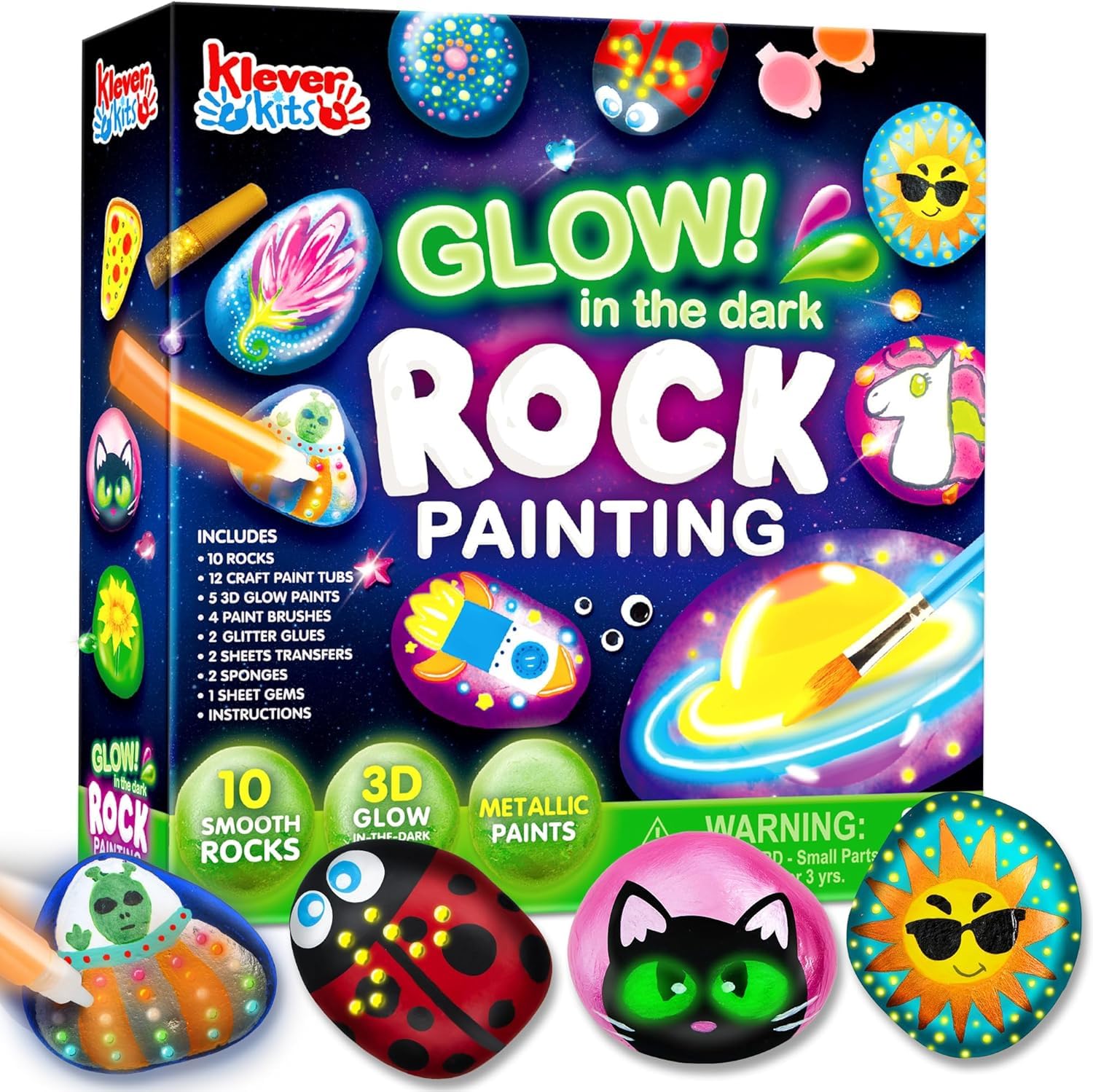
Glow-in-the-dark paint is the promise on the front of the box, and it is the part to be clear-eyed about. The regular and metallic paints go on smooth and cover a white rock in one pass. The glow paints go on thick and bright and look convincing by daylight; after dark the result depends on a heavy coat and a good charge under a lamp, so it varies from rock to rock.

The 44-piece set covers the whole activity — rocks, brushes, glow and metallic paints, decorating bits — with no prep beyond spreading newspaper. Nothing needs mixing, cutting or drying between steps, which is why it works for a group: a table of kids can start within a minute of the box opening and nobody is waiting on an adult for the next stage.

What it is best at is the single afternoon: a birthday activity, a rainy Saturday, or party favors that are not more plastic. It is not a kit that keeps going for months on its own. When the rocks are painted the box is done, though there is paint left to spend on smooth stones gathered outside.

Bottom line: Buy it for one good afternoon: rocks, brushes and paints that work, with a glow effect that may not live up to the box.

#7

Made By Me Window Art Kit

Made By Me Window Art Kit

Window decorating

Doodle Score 9.4/10
Check Price

Worth Noting

  • Finished clings peel away from glass
Pieces
34
Included
Suction cups, cord, acetate sheet, paint pens and tubes
Projects
20 or more
Suncatchers
12
Read the full review

Twelve suncatchers, a sheet of acetate for freehand clings, paint pens and tubes, suction cups and cord: this is the least expensive route here to ending an afternoon with something to hang in the window. The paint is the part that surprised us — thick enough to sit inside the outlines instead of running across the plastic, which is what makes the finished suncatchers look bought rather than made.

The process is simple enough for a four-year-old to manage mostly alone: fill the shapes, let them set, then hang. Thick paint takes hours to dry properly, so the overnight wait in the instructions is not optional. Start the kit in the morning rather than at bedtime, or you will spend the evening explaining why the suncatcher cannot go up yet.

The twelve printed suncatchers are the guided part. The rest of the promised twenty projects are freehand clings drawn on the acetate sheet, which delights a child who draws and frustrates one who wants lines to fill. If yours is the second sort, add a pack of outlines or buy two kits, because the painting itself is worth it.

We rate this one for the doing more than the display. It is the kit we hand over when the afternoon needs filling and nobody wants a project with rules — cheap enough to be a party activity, pretty enough that the results get photographed. Just plan on a window at a child's height, so the re-pressing stays their job rather than yours.

Bottom line: A cheap, satisfying paint session with results worth hanging, as long as you accept re-pressing the clings now and then.

#8

Creativity for Kids Grow 'N Glow Terrarium

Creativity for Kids Grow 'N Glow Terrarium

Science-minded kids

Doodle Score 9.2/10
Check Price

Worth Noting

  • Seeds do not always sprout
  • Plants outgrow the small jar quickly
Grows
Twice
Included
Potting mix, sand, seeds, mister, glow stickers
Jar Size
5 x 3.25 in
Read the full review

This is the only kit here that keeps changing after the box is empty. Assembly takes an afternoon — sand, potting mix, seeds, river stones, two resin figures, glow-in-the-dark stickers — and then the interesting part starts, which is waiting.

The jar is 5 by 3.25 inches, small enough for a windowsill, and the box carries enough seed and potting mix to plant it twice. That second planting is the right call for a first attempt: one jar to learn on, one to try again if nothing comes up. The included mister matters more than it sounds, because a six-year-old with a mister waters a terrarium instead of drowning it, and the nightly check becomes the child's job rather than yours.

Growth is the uncertain part, and it is worth saying out loud before a child starts. Wheat and chia sprout quickly when they sprout, and some jars go green within days while others sit with bare soil. That is the nature of seeds rather than a flaw in the kit, but it means the project can end in disappointment, and a child who has been promised a glowing jungle should hear that first.

We recommend it for the child who already likes the garden, and for the adult who wants a project with a ritual attached — checking, misting, counting leaves. It is the most science-flavoured pick here, closer to a STEM project than an art one, and the glow stickers give it a night-time payoff that keeps a small child interested while the seeds do their slow work. If you need something finished by dinner, choose the window art instead.

Bottom line: For the child who likes growing things more than making things: a small terrarium, two plantings, and a nightly watering ritual.

How We Tested the Best Craft Kits for Kids

We started by scanning bestseller lists and parent forums, then narrowed to kits that were complete (no extra glue or scissors), had a clear age range, and cost roughly what a birthday gift should. We ended up with 14 kits and three months to live with them. Testing happened at kitchen tables after school, on a rainy Saturday morning when the alternative was screens, and at a birthday party where one kit was the main activity. We watched how kids opened the box, whether they needed help with instructions, and how long they stayed before wandering off.

Piece size got checked against the age recommendation first—a kit labeled 4+ with pea-sized beads was flagged. We sorted every component into bowls, then noted whether the kit shorted us on key pieces. Adhesion was tested by gluing two sample pieces and leaving them overnight, then tugging gently the next morning. For glow-in-the-dark kits, we charged pieces under a lamp for ten minutes, then checked them in a dark closet. And we compared finished projects side by side: did they look like the box art, or like a sad pile of foam and pipe cleaners?

Durability meant storing half-finished projects in a bin for a week and seeing what survived sibling tosses. We tracked repeat sessions—a kit pulled out three times was worth more than one abandoned after the first afternoon, whatever the cost. For gift appeal, we noted whether the packaging was nice enough to hand over without wrapping and whether the kit needed batteries or extra supplies. Growth was measured against the age range on the box versus who actually wanted to play; some kits labeled for older kids bored them, while some "too young" kits kept them busy for an hour.

How to Choose Craft Kits for Kids

Project kit or supply box

Craft kits mostly fall into two families. A project kit brings everything for one result — rocks and paint, suncatchers, a terrarium — and stands or falls on that single activity. A supply box such as the Dan&Darci Vault is raw material: a thousand pieces, no instructions, either a licence to invent or a pile of pom poms depending on the child. Drawing sets sit in between, with a defined activity and endless repetition.

The trap is the piece count. A thousand pieces is a thousand supplies, not a thousand afternoons; a 44-piece rock kit delivers a more complete activity than a drawer of beads and feathers.

Check the consumables before anything else

Paint, glue and dough decide whether a kit works on the day it is opened, and they are what let kits down: dried tubes, glue that will not hold, dough gone stiff on a shelf. Open the box before the birthday so a return is still possible, and keep a bottle of school glue in the house for any kit whose glue is the weak item.

Two consumables run out before the rest: the elastic in the bead kit and the paper in the Spirograph set. A spool of elastic and a stack of copy paper are cheap insurance against a kit that stalls.

Age tells you how much help you will give

The age on the box is a supervision guide as much as a safety one. Play-Doh starts at three because the dough is soft and the tools are blunt; the glow rock kit is aimed at six to twelve; the Spirograph gears and fine-line pens want a steadier hand. The useful question is not whether your child is old enough but how many times you will be called over. A kit that needs an adult every two minutes is a kit that stays in the cupboard.

Match it to what your child can already do alone. If they cannot yet cut with scissors, buy the kit that does not ask them to.

Storage decides whether it comes out again

Almost every kit here arrives in some container, and they are not equal. The Crayola case has molded trays that keep markers and crayons apart; the Play-Doh tote is a bag you can flatten into a suitcase; the bead kit's compartments double as the workspace. A thin cardboard box that tears at the corners leaves supplies loose in a cupboard, and loose supplies get used less.

If a kit comes in a plain box, decide where its contents will live before you wrap it, and put the box somewhere a child can reach it without help.

Frequently Asked Questions

Final Verdict

For most families, the Crayola Inspiration Art Case is the kit to buy: 140 pieces, a case that keeps them sorted, and a five-year-old who can use the whole thing without you. It is a drawing set rather than a glue-and-build box, and that is the point — it gets used on ordinary Tuesdays, not only on the days with cake.

If the child in question invents projects and needs material rather than prompts, the Dan&Darci Vault is worth the step up in price. If the child is three, start with the Play-Doh set and its tote. The rest of this list answers narrower questions, which is how a craft shelf should be built anyway.